Sunday, January 23, 2011

Snakes and caps

We got these comments in response to our last newsletter:

Thank you so much for this narration of your visit with my family! I'm … the daughter that was unable to come to Corregidor for this visit. I have been getting emails from my parents and sister telling me about how wonderful their trip has been. And the pictures of my Dad here and on my sister's page brings tears to my eyes. He looks SO HAPPY! I'm sure this was an emotional trip for him and it breaks my heart that I couldn't be there. But I will do my best to join them next year, and the year after that, and the year after that! My dad will be around for a long long time and I know he can't wait to join you again! Thanks so much for taking such wonderful care of my family!
Kimberly Adams C.

---

Dear Steve and Marcia, thank you so much for all your wonderful and amazing works there at the Rock. I greatly appreciate what you are doing there. I want to tell you that I am so move by the articles, stories and reports that I am receiving from your postings. Often, my tears would roll down before I notice it. This recent article created the most. While reading it, my heart kept on saying thank you defenders, do not know you personally, but I am so indebted to all of you for the freedom that we received.
Michael Z.

---

Somewhat overlapping the stay of the Adams Family, whom we talked about in the last newsletter, was a group of four from California, all of whom are WWII history buffs. They joined us on the banca ride to the fortified islands of Manila Bay and the trip up Malinta Hill where Dick Adams identified his 10-day bivouac area. Later on the three men in the group, who can be seen standing under the trunk of a tree in an accompanying photo, joined Steve for several island hikes, looking for out-of-the-way tunnels and gun installations. Melissa decided Malinta Hill had been enough for her knees, and opted to spend her time relaxing and making use of the massage certificate included in their booking package.

One of the most memorable moments for the trio came just after the Malinta Hill hike, which begins and ends at the intersection of the two roads that wrap around the hill, known as Road Junction Forty-three, or RJ43. A tunnel not on the old maps, indicating that it was probably dug in haste by American soldiers at the outset of the war, is found just downhill from RJ43. Since it was so handy, Steve took the guys into the tunnel.

They had not planned to go into any tunnels, so most of the men had smaller than usual flashlights. In Steve’s case, he borrowed a small gizmo that consists of three small lights, clipping onto the brim of a cap. It throws just enough light that you won’t trip over anything. Steve led the way into the 50-yard deep tunnel, not expecting to come across anything too nasty. Suddenly Steve stepped on something that made a crackling/crunching sound, as if he had stepped on a thin drinking glass. At that very instant, the man right behind Steve let out a “holy s—t” scream at least two octaves higher than any grown man should be able to produce. Steve jumped about six feet in the air, landed and ran a few feet forward to get away from whatever it was that had caused the shriek, assuming that it was whatever he had stepped on. When he turned around, several men had their flashlights pointed at a snake that Steve had just passed within inches of. He then realized that the crunch was actually caused by his stepping on a hermit crab at exactly the same time as the man behind him had seen the snake.

The snake itself was calmer than any one of the guys. It lay coiled on an abandoned railroad tie that was about eight inches across. It was coiled a full four times. Based upon this we estimate that the snake was eight to ten feet long. Since cobras don’t exceed six feet here, and the fact that the snake did not act the least bit threatened or threatening, we think that it was a type of python. Accompanying the group was John M. who, like Steve, has been in just about every major tunnel on the island multiple times. John and Steve had only ever seen one snake each in all of their previous explorations of the Corregidor tunnels, so it was indeed a rare event.
Something similar happened a day later, as Steve was leading the men along the Geary to Ramsey trail. When they were passing through a patch of bamboo, Steve’s hat must have brushed up against something hanging overhead. The same man was again right behind Steve. This time the same words came out, but in the more normal vocal range for a man, though loud enough to send Steve another six feet into the air. This time it was just a poor helpless bat, thrashing on the ground trying to get away. Later when Steve offered to take the men into Middleside Tunnel, AKA “Bat Cave,” that particular gentleman decided to photograph the nearby barracks instead. By the way, the Bat Cave once again lived up to its reputation.

One of the members of the group, having read about Steve’s love for Michigan State sports, brought him a Spartan cap and t-shirt. Steve thought this was really nice of him. The cap is made of stretchy mesh and for that reason is literally the coolest cap he has.

After those guests left the island, Marcia and Steve decided to go back into the RJ43 Tunnel a couple of days later hoping to find the snake and take even better pictures of it in order to positively identify it. That’s right: Marcia accompanied Steve on a snake-hunting expedition. Does this sound like the Marcia you know and love? Those who knew her growing up may remember her catching garter snakes on the farm. Anyway, we saw many hermit crabs, a nice land crab and a frog, but no snake. So we have to be satisfied with the picture we have.

Our friend Tom A. stopped by our house this week. Tom is another man who knows and loves Corregidor. He brought us two Texas university caps. Texas Aggies were responsible for a lot of the early construction that was done on the island 100 years ago, and a number held Aggie Musters here before and after the war. Our daughter is at the University of Texas in Austin. Caps from rival schools to add to our collection.

Currently we are in Manila in anticipation of a four-day excursion to Ilo Ilo and Pototan on the island of Panay in the Visayas (Central Philippines.)

Monday, January 17, 2011

Paratrooper Dick Adams returns

We love to welcome returning friends, and to make new ones, on our adopted home of Corregidor. Of course, it is especially exciting to us when we encounter people who come from Minnesota, Wisconsin, and Michigan, where we grew up and spent most of our lives. But our greatest thrill, one that is happening less and less frequently, is to host a returning Bataan or Corregidor war veteran.

To our knowledge, the last American defenders were Chuck Towne and Everett Reamer. They were serving here on Corregidor in 1942 and subsequently had to survive over three years in Japanese prison camps. Chuck and Everett, along with Bataan Death March survivors Malcolm Amos and Richard Francies, were here as part of a contingent that came for the 2006 inauguration of the Hellships Memorial in Subic Bay. Chuck, a corpsman (only females were called nurses) passed away less than a week after returning to his home in Washington State. Everett, who manned a machine gun at Battery Cheney, is still with us, but dealing with health issues that prohibit extensive travel. We often wonder if we will ever see another American defender back on The Rock.

But there is another group of veterans, those who were part of the liberation of Corregidor in February and March of 1945. They did not suffer the years of starvation, disease, and brutality in the prison camps, and on average were a few years younger than the defenders. To our great delight, Richard (Dick) Adams of the 503rd Parachute Regimental Combat Team, part of the fabled “Rock Force,” returned last week with his wife and one of their daughters. We had been anticipating their visit since having lunch with Dick and Nancy last summer in Michigan. The daughter had come for a day-trip early last year, and was excited to accompany them on this trip.

Marcia spotted the trio on the upper deck of the ferry as it pulled into the north harbor. Each tried to see as much of Corregidor as possible while the boat turned around and pulled alongside the dock. We greeted them as they walked down the ramp, and introduced them to island and hotel managers while security men provided a low-key honor guard. Multiple photos were snapped. Dick’s initial reaction was, “Things sure look different now!” They climbed aboard the tranvia, accompanied by other visitors, a small film crew, a few fellow Corregidor lovers who had come to meet and assist a returning veteran, Marcia, and Steve as guide.

Dick, a somewhat reticent gentleman, wanted to minimize the “hoopla” while here. There was a very simple but moving ceremony at the 503rd PRCT marker at Topside, attended by some of the other tourists as well as our group, with solemn raising of Philippine and American flags followed by presentation of a floral arrangement. Dick seemed a little surprised by the number of tourists who approached to shake his hand and request photos with him.

His main goal was trying to find the areas he remembers from his time on the island in 1945: the golf course landing zone; the hillside cliff where the wind brought him down; the building which held the aid-station where he brought injured fellow paratroopers; the officers’ quarters building near which he lost – and later found – his Miraculous Medal; the huge water tanks between which he spent two nights as perimeter guard, sleeping in shifts with a buddy; and the area on Malinta Hill’s north side where he and five other men bivouacked for ten days and nights.

Having been told that Dick was coming, two of the premier Corregidor explorers, Karl Welteke and John Moffitt, were able to join us as we tried to locate the spots that Dick particularly wished to find. We started by climbing the lighthouse, from which Dick hoped to spot the golf course area near his landing site. As we had warned him, trees block any possible view, but it did help him to orient himself to the Topside area.

Next we went to the easiest place of all to locate, the water towers which are just yards from the foot of the light house. Dick was satisfied that he’d found the sleeping spot. We proceeded to the senior officers’ housing area nearby. We could not be sure of the exact location, but we knew we were in the area where he lost and found his Miraculous Medal, and the stairs he used to get up to the aid station. From there it was only a short walk to the swimming pool, roughly across the road from where Dick had landed on the cliff face. Of course the area is overgrown with jungle, but we could at least make a reasonable guess as to the area.

The following day began with a banca trip around the fortified islands of Manila Bay. It is not an exaggeration to say that the wind was calmer and the sea smoother than they had been since at least the first day of November. It was a marvelous trip, and we were joined by four other Americans whose visit overlapped with the Adams’. Later we all walked up Malinta Hill, and Dick was pretty sure he found the spot where the six men ‘hung out’ for about 10 days. By the way, Dick, who is 88 and in great shape, didn’t slow us down on a hike that includes a few short, steep ascents.

The following day was just the opposite weather-wise. It was easily the windiest and waviest day since the first of November. We can usually say that tomorrow’s weather will be about the same as today, but this was the most marked day-to-day change we’ve seen except for when typhoons affect Corregidor.

We joined the Adams family for lunch and dinner each day, and have to say that we were already missing them as we said our goodbyes at the pier.

Will this mark the last return of an American liberator to Corregidor? Not if Dick has anything to say about it! He and his family had such a wonderful time that they are seriously thinking of returning next year, when their other daughter may be able to join them. We sincerely hope that this will happen, and want to encourage any other defenders or liberators of the Rock to return as well.

You can read more about Dick’s adventures here 66 years ago, including the Miraculous Medal story at: http://steveandmarciaontherock.blogspot.com/2010/03/bats-flies-and-parachutes.html

Monday, January 10, 2011

Spending time with Corregidor regulars Bill and Midge

From reader Galo Calizo regarding comments in last newsletter:

Happy New Year! Thank you for making us feel at home, vicariously!

I get so happy reading your ‘blog’ every now and then. Thank you for touching the lives of the poor Filipinos there and thank you for embracing our culture and making it seem like it is such a wonderful paradise. Yes, we are happy people despite all the insurmountable odds that come our daily way and we are proud of that.

Thank you! I hope to meet you soon!

Thank you, Galo, for your encouraging email. We continue to be amazed by the Filipino people, many of whom work hard to make it from day to day, but keep on smiling.

Our friends Bill and Midge Kirwan were here for their semi-annual “Corregidor retreat.” Both retired and living on Chesapeake Bay, they spend part of each year in Southeast Asia. Bill teaches psychology and they both offer counseling. On days when Steve was not guiding tours, he and Bill hit the jungle trails, and Marcia and Midge walked along the paved roads while catching up with each other’s lives.

One day the guys took the recently-cleared trail from Battery Ramsey to Battery Geary. It passes by the old crematory, going downhill to the point where heavy bamboo, now cleared, had kept Julia, Jill and the two of us from passing a month ago. Along the way there is a noble stand of bamboo which would be great for many things including banca outriggers, but it is so deep in the jungle that it would be nearly impossible to haul out.

A little further along the trail is an area that has been nicknamed “the wall of caves” for good reason. There are multiple cave entrances attributed to the U.S. Marines along the base of the rock wall, many of which reportedly connect, but which are small enough that we have not chosen to go inside to find out for ourselves. Just opposite a section of that wall is a point of land providing one of the best views overlooking Caballo Island and the Province of Cavite.

Now that this trail has been cleared, the most difficult part of the hike is right at the end, just below Battery Geary. In the past the trail continued straight ahead, running parallel and below the main road toward Topside, but a landslide, probably from a WWII bomb,– makes it nearly impossible to proceed, the path being covered with loose stones and steeply angled. So the alternative is to ascend about 40 feet at a near-45 degree incline to a ridge just above the battery. We’ve tied a rope to the base of a tree at the top and knotted it every two feet, so it’s not too difficult as long as your hands don’t slip and you watch your footholds. It is definitely easier to climb up than to go down. Bill is a former John Hopkins lacrosse player who swims 3,000 yards a day when he is home, so with his upper-body strength he had no trouble, despite arthritic knees and a fast-approaching 73rd birthday. Steve has comparatively stronger legs but weaker arms, finding the climb slightly more difficult for him than Bill.

Another time Steve and Bill walked from the power plant at Bottomside to a Japanese anti-aircraft gun emplacement above the plant. There are four other AA guns that were moved from their original locations to the Japanese Memorial on Tailside. Writing on these guns indicates that they were manufactured in Hiroshima during the war.

On Wednesday Steve guided a Sun Cruises tour group, which was a mixed bunch from places as far away as California, USA, and Germany. Three of the tourists were avid bird watchers. Paul, another of the men on the tour, originates from Liverpool, England, but now resides in Angeles City near the former Clark Air Force Base. He was here with his girlfriend, Marnie. All of these people stayed overnight, and Steve was able to introduce Marcia to them at the sunset viewing. The following day, Steve led Bill, Paul, and Marnie up Malinta Hill. Paul was so impressed with the island and Steve’s love for Corregidor that he intends to return with a couple friends and spend a few days exploring the jungle trails.

After the hike, Steve stopped at the Corregidor Inn to pick up Marcia, who had again been visiting with Midge. We decided on a light lunch at MacArthur Café, and there were the bird watchers. They were very pleased with how many birds are here on Corregidor, having identified 33 species of birds within about two hours of walking the main roads. It was helpful for us to talk with them and look through their bird book to clarify some of the birds we’ve seen and heard, since we only have a small and very limited pocket guide and are still unfamiliar with many of the bird calls and songs.

During their days here, we joined Bill and Midge for several sunset viewings from Battery Grubbs, but one of our favorite sunsets was seen from the north beach near MacArthur’s Café where we were going to eat dinner. Although we didn’t see the sun itself, since it was behind Topside (left of picture) from where we were standing, the effect over the Mariveles Mountains (center) was beautiful. We hope the panoramic photo does it justice.

On Saturday Steve and Bill took the old trails from Battery James to Battery Smith. Bill was especially interested in the James Ravine area, having recently read a book by General E. M. Flanagan, Jr., entitled Corregidor: The Rock Force Assault. The book describes in great detail the brutal action that took place in that area in February of 1945, when the Americans rooted out the seemingly fearless and obstinate Japanese from the caves and tunnels in the ravine. Later, the four of us joined Ronilo at his house for bulalo (a traditional Filipino beef knee/shank soup) and, of course, rice and beer.

Bill and Midge left on Sunday, but not before Steve and Bill went looking for a storage building near Battery Wheeler where dozens of Japanese had holed up and were ultimately killed by American artillery. Marcia and Midge spent their last ‘girl time’ while the guys were exploring. Finally it was time to bid the Kirwans goodbye until we meet again, probably next January.

We are so thankful for email, which enables us to stay in contact with them and many other friends and family members.

Friday, December 31, 2010

Christmas Eve to New Years Eve

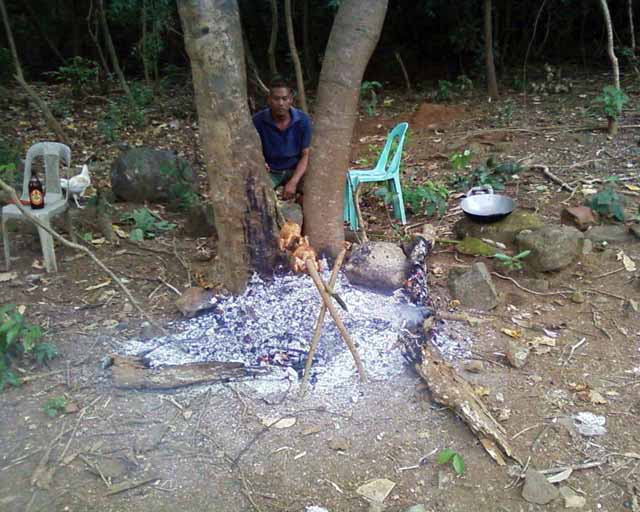
On Christmas Eve, after a beautiful sunny day with a high in the mid-80s, we went to Ronilo’s house for dinner. Earlier in the day we had given two large chickens, about three pounds apiece, to Ron for roasting. Later when we arrived, Jhun was slowly turning the chickens over hot embers. The spit is a use-once-and-throw-away bamboo pole (see picture). The birds were stuffed with lemongrass and tamarind, and had been coated with patis, a clear, salty/vinegary concoction that is commonly used for seasoning here. Ron had wanted us to bring our computer so that we could watch an action movie, and we wanted to watch something with a Christmas theme, so we settled on “Die Hard,” a shoot-em-up thriller that takes place during a Christmas party. Ho ho ho.

Our dinner started with talakitok [tah-lah-KEY-toke] soup, which includes whole chunks of fish and camote (sweet potato) leaves, along with the ubiquitous serving of rice. Then came the delicious chicken, and plenty of Red Horse beer, the beer with a kick.

We thought that we would be going straight home after the dinner and movie, but Ron had something else in mind. The four of us went down to the contract workers barracks, or “barrio,” where many of the island workers reside. Because of the holidays, many of the families are reunited for a few days, wives and children usually coming to join their husbands and fathers, who live here away from home to work and support their families. By American standards these are financially very poor families. Despite the very simple lifestyle, the children seem happy, a phenomenon that we witness whenever we travel through the Philippines.

These children cannot look forward to the kinds of gifts common to our childhoods. Ron’s idea was to go to the barrio and give each of the children at least something. When we arrived, plates of food were placed on the table in front of us, and despite already being stuffed we politely ate a bit of each offering. The next thing we knew, more Red Horse arrived.

Ron began to ask the children for Christmas kisses, and as they came up and kissed him on his cheek he gave each one a 20 peso (P20) note, worth around 45 cents apiece. Then the children danced to music, with Ron handing out additional P20 notes and joining occasionally in their dancing. Taken by surprise, we had no camera with us, and since it was dark and the cell phone camera has no flash, it was not up to the job. Nonetheless, we are including a couple of fuzzy pictures of the children just so that you can get some kind of impression.

On Christmas morning, we woke to a surprisingly chilly-feeling 79 degrees, according to our very unofficial thermometer from the school-supplies section of National Bookstore. We continue to be amazed that we, who grew up in Minnesota and spent most of our lives living in northern states, can find this temperature cool enough to make us get out warmer clothing.

We’ve mentioned how Steve has run into a number of people who are from our home states of Minnesota and Michigan. Only once has he seen any apparel from Michigan, when a man from Grand Rapids was wearing a University of Michigan baseball cap. Steve’s been longing to see something from Michigan State University, and this week it finally happened. A young lady in one of his “walk-in” tour groups was wearing a white hat with a green “S” on the front, and sure enough, on the side it said, “Spartans.” (“Walk-in” is the term for a tourist who arrives on Corregidor via banca rather than Sun Cruises’ ferry.) Steve said to her, “That’s my school, the Michigan State Spartans,” only to be met with a blank look. The lady was in a group of Ilocanos from Baguio, the city in northern Luzon known as “naturally air conditioned” due to altitude. Unsurprisingly, no one in the group of 30 had ever heard of the school, but, again not surprisingly, they all knew of Magic Johnson. Magic, of course, led the Spartans to their 1979 NCAA National Basketball Championship before leaving college early to join the Los Angeles Lakers and lead them to a few NBA titles. In the Philippines, MSU stands for Mindanao State University, a far cry from Michigan State, fondly known in mid-Michigan as “MSU” or simply “State.”

The next day, Steve struck up a conversation with a man in his Sun Cruises tour group who appeared to be an American. Steve asked, “Where are you from?” “California” was the response, but with a slight drawl. Steve said, “You certainly didn’t grow up there,” and the man replied, surprisingly, “No, Michigan.” “Where in Michigan?” It turns out that he grew up in Lansing, where we lived for most of the last 30 years. DeVone said that his brother Daniel is head-coach for football and track and field at Lansing Sexton High School. DeVone is visiting the country with his Filipina wife Nerissa, son Caleb, and daughter Imani. DeVone is the first Lansing native we’ve met here on Corregidor.

Another family on the same bus had three young children. The mother is Chinese and the father is from Germany. They said that their children are becoming fluent in English, Mandarin, and German. What an advantage to be able to master multiple languages as children, when they soak it up like sponges.

Filipinos love to use anagrams, nicknames, and abbreviations. The previous president, Gloria Macapagal Arroyo, was almost always referred to as GMA. Her predecessor, Joseph Estrada, was “Erap.” Current President Aquino is “Noy,” Noy-Noy,” or “P-Noy.” Headlines in the paper are often abbreviated to the point of being indecipherable. An example from the Dec. 29 Philippine Star: “NCRPO chief inspects LRT, MRT”. Fortunately the first paragraph read, “To prevent the spillover of the Sulu violence in Metro Manila, National Capitol Region Chief Director Nicanor Bartolome inspected yesterday the Light Rail Transit (LRT) and Metro Rail Transit (MRT) platforms and stations to ensure the safety of the riding public.” A Dec. 26 Star headline read: “Cayetano lauds DOLE for resolving PAL-FASAP row”. Huh? The Star writers do spell out the names for almost every anagrams used within an article, but that doesn’t seem to be policy in all publications, greatly frustrating the non-daily reader.

Our New Years Eve celebration was pretty quiet, with just Ron, Rex - the new island radio operator, and the two of us. Dinner was again a two course meal, beginning with a radish salad we brought and fish soup, sapsap in a wonderful lemongrass broth. Ron brought out several small tangerines and an apple, reminding us of the Philippine custom of inviting prosperity in the New Year by displaying round-shaped fruits in the home. We progressed to grilled chicken, manually rotisserie-cooked by Rex and Marcia, and then began watching the first Terminator movie on the laptop. It started to sprinkle, not good for the computer, so decided it was time to head home.

With that we leave you with the following headline: “SMR wish you HNY!”

Thursday, December 23, 2010

Merry Christmas
and
Happy New Year
from
Steve and Marcia on the Rock

Wednesday, December 15, 2010

The confession; Chistmas party

Kathy S. was Steve’s last manager as an employee at the State of Michigan. Recently Kathy sent us an email saying that she is retiring before the end of the year. This sparked Steve’s memories of the three years he worked for Kathy, and in particular, one incident which he has shared with no one except Marcia.

When he first worked for Kathy, Steve’s job was installing new servers at the three Lansing-area computer centers. They would arrive in large boxes from Dell and HP. He would unbox them, place them into preassigned racks, and hook up all of the wiring necessary to prepare them for the computer techs who loaded the software and put them online. The majority of the installations were done at one site, so Steve was given a computer and space to more-or-less set up an office in a room across the hall from his delivery storage room.

To understand “the rest of the story,” it will help to have some background. At the time we were very familiar with the Jerry Seinfeld Show. We’d seen the reruns often enough that, when talking with other Seinfeld fans, we could make one another laugh simply by mentioning an incident from one of the episodes, such as “calzones,” “serenity now,” or “toothbrush in the toilet.” Some of you readers know exactly what we’re talking about.

There was one particular episode in which Jerry had a man install new cabinets in his apartment. As it turned out, Jerry hated them and had them ripped out. However, George Costanza was inspired to have the handyman come to his office in Yankee stadium, where he was an executive – that in itself is laughable if you know George – and he had the man build a bed underneath (basically into) his desk. George spent his days sleeping right in his own office, and whenever anyone came to the office and didn’t find him there, would assumed he was hard at work someplace else. Eventually George was discovered in his hideout by the grandchildren of Yankee owner George Steinbrenner, but the kids kept their mouths shut and he did not get caught.

One day, after seeing this episode, Steve was in his tiny converted storeroom “office” and the thought occurred to him: would it be possible to set up a sleeping area right there? He was sitting at a desk like those that have become so popular, the ones where modular walls and cabinets and drawers and desks are set up in huge office spaces, creating mazes of virtually identical boring cubicles. However, in Steve’s case he had just enough pieces to hold up a desk with a cabinet above it, but not enough for an actual cubicle. To the left as he sat at the desk was the door, and beyond that another desk, also of modular design. The space under the second desk was empty except for the carpet. Because of all the trash created each time computer servers were unboxed, a large rolling trash box was also kept in the room. It was as tall as the desktop and slightly shorter.

So the idea hit him: if I could get under the desk and manage to pull the box up next to myself, I would have a perfect little hiding place. Now before we go any further, Steve just wants to assure Kathy and his fellow State workers that he had no intention of actually using this as a place to shirk his duties and take naps, but he just had to see if it would work – must have been that voice in everyone’s head that says, “Go ahead, see if you can do it.” So that’s what he did. It was winter, so Steve was wearing his cowboy boots and had his winter coat with him. He kept his boots on, since if someone came in and saw them ‘unoccupied’ he would know Steve must be very nearby. He took the coat, rolled it into a pillow, and crawled under the desk. He was able to roll the trash bin into place, and for a couple of minutes he lay there in semi-darkness just kind of laughing to himself, thinking that indeed this might work.

Moments later, just as he was about to get up, Steve heard Joe C., the computer room manager. Joe was talking in his usual loud voice, and he was obviously with someone. Steve could hear him say, “We’ll get Steve to help you.” Steve froze, thinking, “Oh, crap, now what?” Sure enough the door opened – Joe was one of the very few who had a key – and in walked Joe with someone whose voice Steve did not recognize. He thought, “What am I going to do if they spot me under the desk?” The box was a good foot shorter than the desk space, so his cowboy boots were visible past the end of the box. He couldn’t curl himself more tightly because any movement might have given him away. Fortunately his boots were against the far wall and Joe had no reason to go that far into the room. Steve could actually see Joe through a slit between the desk and the box. Steve held his breath as Joe said, “I just can’t understand it, Steve is usually here.” Then they left the room to look for him elsewhere in the data center. Steve quickly scrambled up, went quietly out of the room, and walked in the opposite direction from the one which they had taken, managing to soon be found by Joe and companion.

As you can imagine, Steve never again crawled under that desk. But it still makes him smile to think of himself hiding under there, hoping that Joe would not spot him, and wondering what he would have said if Joe had.

At least here on Corregidor, if Steve needs to hide from Marcia there are hundreds of caves where she’d never find him…but who knows what else might be hiding there?

We wish Kathy S. a very happy time in retirement, and hope that we can visit with her and some of the gang next summer. Our best wishes also to Al S., Steve’s good friend and co-worker, who also recently took advantage of a State of Michigan early-retirement offer.

In answer to last week’s question of how a beam of sunlight that passes through a round hole could project an apple-shape, two of our readers got the right answer. The wall on which the light fell is not smooth, but seamed and curved. If you look at the enclosed picture, “Parachute Dome,” you can see the exterior ribbing on the dome. Indented seams on the inside correspond with these ribs. Looking at the interior, each panel has a recessed spine which splits into curves going right and left at its lower portion. Thus the light has to travel further into the spine, and this causes the apple-shaped distortion in “Sunspot one.” In “Sunspot two” the sunlight is centered near one of the indented seams, so the sunspot shape is elongated at the top as it covers the curves of the two panels, resembling a shield in shape. So far, no one has proposed a better word for the projected sunlight which we called a sunspot.

Finally, last night was the annual all-island Christmas party. School is out, so many of the staff-members’ children are here. A good time was had by all, with plenty to eat and drink as well as games, music, and dancing, with some dances led by a professional instructor from Metro-Manila who came with our friend Beth. We’ve included a few pictures from the festivities.


Wednesday, December 8, 2010

More exploring and tour guiding

Last Sunday Julia Holz, about whom we wrote in our last newsletter, returned with her friend Jill for one last 2010 trek on Corregidor. We had met Jill briefly last year, and she is another Corregidor hiker of many years’ experience. Since they planned to walk a familiar section of trail, one we had never explored, they invited us to join them. The plan was to walk the path which starts just before the War Memorial Zone archway and heads around the southern end of the “head” of the island. Since they were not planning to stay overnight, the decision about which upcoming fork in the road to take would be determined by our progress.

They wanted to start their day with a pancake breakfast, so we met Julia and Jill at the Corregidor Inn at 10:30. That left us more than three hours to hike, plenty on a warm, very humid day in early December. At first the trail was through an area of heavy vines that remotely resemble kudzu. This type of vine is taking over parts of the island, climbing up into nearby trees and completely draping some places. Since we were on the south side of the island, wherever the trail was open to sun it was overgrown with vines, tall grass, or small trees, but in shaded spots there was almost no growth at ground level. Just past an old pump house, we had to very carefully climb down from an old bridge and up the other side of a ravine. It took some hacking with the bolo to once again find the trail. Then we had mostly clear sailing along an old trail that had been cut into the side of the steep hill. Quite often pre-war sidewalk was partially visible.

We went past a trail that led down toward several of the old searchlight positions. Maybe someday when we are again looking for adventure we will try to see if it is possible to follow it. Eventually we came to a sharp turn back up the hill. When we got to the fork in the trail that would either take us to Battery Ramsey or Battery Geary, we decided to take the shorter path to Ramsey. Soon we ran into a massive growth of bamboo. We were not exactly sure where the trail was, all traces having been obscured. Steve hacked at the bamboo for a while, got completely tuckered out, and decided to try to crawl through it instead. After working his way maybe 50 feet, he still couldn’t pick up the trail. In the meantime, the ladies were all trying to find an alternate way through or around the bamboo thicket.

Steve crawled back out – but not before taking one wrong turn and getting really entangled. At this point we decided to try the trail up toward Geary. We walked a few hundred feet and gave up, having encountered another area of heavy overgrowth. We decided that we had best turn around and retrace our original path to make sure that Julia and Jill could make it back on time for the ferry. Since they were under time constraint and we were not, and since Steve was pretty exhausted from all the bolo work, Julia and Jill went on ahead while we took our time. It was frustrating. We knew that we had been close to picking up the trail, from which point we would have had a relatively short, uphill walk to Battery Ramsey, which is only across Middleside Parade Ground from our house.

Soon Julia and Jill were beyond hearing range, and the two of us meandered along the trail. We were happy to hear that they’d gotten back with enough time to shower before getting onto the boat. By the time we reached Bottomside, drenched in sweat, the ferry was preparing to pull away from the dock. We stopped at Mac’s Café for a late lunch/early dinner, especially enjoying some cold Coca Cola. In spite of the frustration, it was an enjoyable day, good time spent with friends, an introduction to a new-to-us section of trail, and well-earned rest at the end.

On Tuesday Steve led an alumni tour for the 1956 class of Ateneo High School, at that time a boy’s college-prep school in Manila. Our friend Ray Ong was a member of that class. He said that class-members gather as often as four times a year, sometimes in the Philippines and other times in the States. A total of eight classmates came for the tour, as did one spouse.

Then on Wednesday Steve guided for recently commissioned 2nd Lieutenants from the Philippine Marines. We included a few pictures taken during their tour. He really enjoys guiding for groups like the Ateneo alums and the Marines who have a special interest and appreciate his love of the war-time history.

While at topside during a recent tour, Steve was showing how the sun casts a sunspot – just what is the opposite of a sun shadow, anyway? – through the opening at the top of the parachute dome. (The word for such an opening at the top of a dome is “oculus” for those of you who, like we do, enjoy unusual words.) He was telling the guests that the dome is designed for the sunspot to fully illuminate the surface of the circular altar beneath the dome at noon on May 6 every year to commemorate the anniversary of the Fall of Corregidor. Usually when you are under the dome on a sunny day you can see the spot somewhere. The hole is circular, and the sunspot on the ground is oval in shape except when the sun is directly overhead. But on this day and time, the spot was higher, on the parachute structure itself. To Steve’s amazement it was neither circular nor oval, but shaped like an apple, so he photographed it with his phone and the picture is included here as an attachment. It took a minute for the group to figure out why the spot had such an unusual shape. There is a logical explanation. Can you guess what it is?