The American Women’s Club of the Philippines has invited us to be guest speakers at their General Meeting to be held this coming Wednesday, November 9. The meeting is open to the public, runs from 9:30 to about 11:30, and includes breakfast. The cost is p500 for non-AWCP-members, p300 for members. The meeting will be held in the Palm Grove Room of the Rockwell Club, which is in the Amorsolo Building in Rockwell Center, Makati. The address is : # 23 Amorsolo Drive, Rockwell Center, Makati City.
Also, we will once again be attending the Veteran’s Day Ceremonies at the American Cemetery in Manila on Friday, November 11. Those who wish to attend are asked to arrive no later than 10:30 if coming by private car, since all vehicles entering the cemetery will have to be cleared by security. If you are dropped off outside the gate, you can walk or catch a short shuttle ride to the ceremony area. It is requested that all are seated by 10:45.
We hope that we can see some of you at one or the other of these events.
Steve and Marcia on the Rock
Sunday, November 6, 2011

Friday, October 28, 2011
2011 Corregidor Basketball League
The 2011 Corregidor Basketball League Tournament got underway this week. As is traditional, the teams lined up at the administration building and paraded to the basketball court. Then they were introduced in their new uniforms, some of which were not delivered until an hour before opening ceremonies. Another tradition is the team “muse.” Each team has a young lady in her ladies’ style unif orm, and the muses perform individually for the audience. One muse presented an a capella vocal number, two did solo dances, and two performed partnered dances.
Then it was time for the ceremonial opening toss. Steve, the CBL commissioner – i.e., the one who raises the money to fund the to urnament – was at center court with inn manager Ed, island manager Ron, and the captions of the first-game teams. By luck of the draw, the opening game pitted Battery Way, captained by our helper Roy, and Battery Geary, led by the 2008 tournament’s MVP Jerry. By the way, many Filipinos pronounce Geary more like JEER-ee, so that is why Jerry decided to go with Battery
 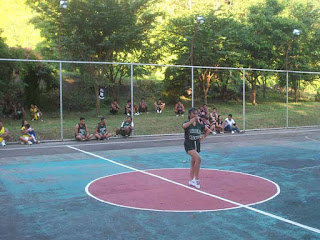 Geary for his team name.
The opening game was probably the most exciting of the first week, with Battery Way edging Battery Geary in “The Battle of Mortars” 60-58. Because it was opening day the players had asked to schedule two games, and in the second, Battery Grubbs beat Battery Crockett in “The Battle of Disappearing Guns” by 53-47. Steve worked out a five-team schedule so that no team would have to play two consecutive days if only one game per day was played. However, because of the two games held on opening day, Battery Way had to play again on day two, facing Battery Hearn – the lone “Long Gun.” On top of being scheduled on consecutive days, only five of their players were suited up at game time, versus all eleven players for Battery Hearn. This was partly due to men who had previously scheduled vacation and were off-island, an unavoidable challenge for every team. Battery Way fell behind early, with a sixth teammate not arriving until the 4th quarter. Battery Hearn won 70-62.
On the third evening, Battery Geary defeated Battery Crockett 64-52. On the next night, completing the first week’s schedule, Battery Grubbs beat Battery Hearn 68-54, having gained a 21-4 lead early in the game. Battery Hearn was never able to draw closer than ten points, and this left Battery Grubbs as the only team to be undefeated after playing two games. Next week includes Halloween, All-Saints Day and All-Souls Day, important days here in the Philippines, so it will be a short week for basketball. The five teams will ultimately play each other twice, followed by championship playoff games.
By the way, the uniforms look very nice, and each team has a slightly different style. Battery Way is a royal blue with white trim, Battery Geary is canary yellow with green, Battery Hearn is white with blue, Battery Grubbs is black with red and white, and Battery Crockett is dark green with white and black. The total cost – for fifty-six player uniforms, five muse uniforms, four committee shirts, and two referee shirts – was p37,200 (about $855). Compare that to a recent Michigan State University game in which Nike reportedly paid $200,000 (almost nine-million pesos) to outfit MSU with what some stated were the ugliest uniforms on the planet (one man called them “jammies”)…to be worn for one only game, against the University of Michigan, who also wore reputedly ugly one-game “throw-back” uniforms.
Hikers occasionally s till discover pre-war relics. While our friend Karl was here he happened upon a large pitcher, the kind you often see with old-fashioned pitcher-and-basin sets. It is white enameled metal, and not in great shape – until you recall that it has lain in the jungle for about 70 years. It actually cleaned up fairly well, but has several holes an
 d the handle is missing. The initials, “U. S. A.” and “M. D.” appear to be stamped on the bottom. Perhaps one of you readers can tell us what the “M. D.” stands for.
We wish to bring your attention to an artifact which is slowly disintegrating here on the island, and want to know your opinions on whether or not anything can and/or should be done about it. On February 16, 1945, the Americans landed on Corregidor to recapture the island from the Japanese. Members of the 503rd Parachute Regimental Combat Team first landed at Topside. We have learned that the first American flag raised that day was not at the historic Spanish Flagpole, the site of the ceremonial flag raising upon MacArthur’s return on March 2nd, which stands at the southeast corner of the Topside Parade Ground. It occurred on a flagpole that stood near the Post Improvement Building, down the hill and across the trolley line which ran west of the Parade Grounds.
Several of our explorer/history-nut friends are certain that they have located that flagpole. Or at least what little remains of it. As you can see from the picture, it now consists of several pieces of wood in the concrete-lined 14- inch hole which formed the flagpole base. Our friend Karl is standing next to it. It appears to have been burned down to around two-feet high. Assuming that this is in fact the actual base of this less-known but very historic flagpole, should something be done to preserve what is left of the pole? One suggestion would be to remove the few pieces of wood that are left and exhibit them, maybe in the museum or near the Spanish Flagpole. We also wonder if folks with ties to the 503rd PRCT might wish to sponsor a permanent marker to be placed in or beside the actual flagpole base.
Finally, about the pastry gift we received from Hitomi: Father John Nariai said, “The Japanese goody in the photo that you ate is ‘Shun no nama Yatsuhashi’ that is ‘dry cookie made of sweet potato, pumpkin and Japanese chestnut.’ It is baked only in spring and autumn.” Juan M. wrote, “My Japanese colleague here at work tells me it’s a type of Japanese ‘Hopia’ called Manju in Nihonggo.”
 orm, and the muses perform individually for the audience. One muse presented an a capella vocal number, two did solo dances, and two performed partnered dances.
Then it was time for the ceremonial opening toss. Steve, the CBL commissioner – i.e., the one who raises the money to fund the to
 urnament – was at center court with inn manager Ed, island manager Ron, and the captions of the first-game teams. By luck of the draw, the opening game pitted Battery Way, captained by our helper Roy, and Battery Geary, led by the 2008 tournament’s MVP Jerry. By the way, many Filipinos pronounce Geary more like JEER-ee, so that is why Jerry decided to go with Battery
  Geary for his team name.
The opening game was probably the most exciting of the first week, with Battery Way edging Battery Geary in “The Battle of Mortars” 60-58. Because it was opening day the players had asked to schedule two games, and in the second, Battery Grubbs beat Battery Crockett in “The Battle of Disappearing Guns” by 53-47. Steve worked out a five-team schedule so that no team would have to play two consecutive days if only one game per day was played. However, because of the two games held on opening day, Battery Way had to play again on day two, facing Battery Hearn – the lone “Long Gun.” On top of being scheduled on consecutive days, only five of their players were suited up at game time, versus all eleven players for Battery Hearn. This was partly due to men who had previously scheduled vacation and were off-island, an unavoidable challenge for every team. Battery Way fell behind early, with a sixth teammate not arriving until the 4th quarter. Battery Hearn won 70-62.
On the third evening, Battery Geary defeated Battery Crockett
 64-52. On the next night, completing the first week’s schedule, Battery Grubbs beat Battery Hearn 68-54, having gained a 21-4 lead early in the game. Battery Hearn was never able to draw closer than ten points, and this left Battery Grubbs as the only team to be undefeated after playing two games. Next week includes Halloween, All-Saints Day and All-Souls Day, important days here in the Philippines, so it will be a short week for basketball. The five teams will ultimately play each other twice, followed by championship playoff games.
By the way, the uniforms look very nice, and each team has a slightly different style. Battery Way is a royal blue with white trim, Battery Geary is canary yellow with green, Battery Hearn is white with blue, Battery Grubbs is black with red and white, and Battery Crockett is dark green with white and black. The total cost – for fifty-six player uniforms, five muse uniforms, four committee shirts, and two referee shirts – was p37,200 (about $855). Compare that to a recent Michigan State University game in which Nike reportedly paid $200,000 (almost nine-million pesos) to outfit MSU with what some stated were the ugliest uniforms on the planet (one man called them “jammies”)…to be worn for one only game, against the University of Michigan, who also wore reputedly ugly one-game “throw-back” uniforms.
Hikers occasionally s
 till discover pre-war relics. While our friend Karl was here he happened upon a large pitcher, the kind you often see with old-fashioned pitcher-and-basin sets. It is white enameled metal, and not in great shape – until you recall that it has lain in the jungle for about 70 years. It actually cleaned up fairly well, but has several holes an
 d the handle is missing. The initials, “U. S. A.” and “M. D.” appear to be stamped on the bottom. Perhaps one of you readers can tell us what the “M. D.” stands for.
We wish to bring your attention to an artifact which is slowly disintegrating here on the island, and want to know your opinions on whether or not anything can and/or should be done about it. On February 16, 1945, the Americans landed on Corregidor to recapture the island from the Japanese. Members of the 503rd Parachute Regimental Combat Team first landed at Topside. We have learned that the first American flag raised that day was not at the historic Spanish Flagpole, the site of the ceremonial flag raising upon MacArthur’s return on March 2nd, which stands at the southeast corner of the Topside Parade Ground. It occurred on a flagpole that stood near the Post Improvement Building, down the hill and across the trolley line which ran west of the Parade Grounds.
Several of our explorer/history-nut friends are certain that they have located that flagpole. Or at least what little remains of it. As you can see from the picture, it now consists of several pieces of wood in the concrete-lined 14-
 inch hole which formed the flagpole base. Our friend Karl is standing next to it. It appears to have been burned down to around two-feet high. Assuming that this is in fact the actual base of this less-known but very historic flagpole, should something be done to preserve what is left of the pole? One suggestion would be to remove the few pieces of wood that are left and exhibit them, maybe in the museum or near the Spanish Flagpole. We also wonder if folks with ties to the 503rd PRCT might wish to sponsor a permanent marker to be placed in or beside the actual flagpole base.
Finally, about the pastry gift we received from Hitomi: Father John Nariai said, “The Japanese goody in the photo that you ate is ‘Shun no nama Yatsuhashi’ that is ‘dry cookie made of sweet potato, pumpkin and Japanese chestnut.’ It is baked only in spring and autumn.” Juan M. wrote, “My Japanese colleague here at work tells me it’s a type of Japanese ‘Hopia’ called Manju in Nihonggo.”
Monday, October 17, 2011
Various things and another passing
Over the years we have made a number of Japanese friends. These are people who feel that there should be more emphasis on informing the Japanese public about what really happened in WWII, rat her than to ignore that part of their history. On occasion one or more will visit the Philippines, often asking Steve to show them around Corregidor. Recently we were contacted by a young student by the name of Hitomi, referred to us by mutual acquaintances in Japan.
It just so happened that we were returning from a quick trip to Manila on the same day that Hitomi was coming to Corregidor. All we knew was that she was young and female, and Japanese. Going on that information, we looked for her on the uncrowded Sun Cruises ferry. By coincidence the first two young ladies that Steve approached were not Hitomi, but he soon found her. The other two decided to also join Steve’s bus. Hitomi was prepared to hear about some of the Japanese atrocities associated with Corregidor and Bataan, but Steve had no idea about the other two women, so he spent a couple of minutes addressing the three of them, assuring them and the other guests that the material he would present over the next few hours was no reflection on them or the present-day Japanese people, but was intrinsic to the story of Corregidor.
Joining the three of them for lunch, Steve discovered that, indeed, the other two young women were somewhat surprised, but were also very open to hearing the truth. They parted as friends, thankful for the opportunity to learn about Japan’s WW II role in this area of the Philippines. As is customary among many Asians, Hitomi gave us a popular Japanese treat. We are including a picture of the ornate box cover. Inside were three each of three different kinds of sweet, paste-filled pastries. The outer layer was similar to the wrappers used in making wontons and egg-rolls. Maybe someone can tell us what we were eating. They were very unlike any of the pastries we are accustomed to eating in the US. One filling was like confections made here in the Philippines using the purple sweet potato called “ube” (Tagalog for the color purple.) Another was chocolate, and the third was a yellow-orange color with a flavor similar to mango or apricot.
On Sunday Steve was asked to escort a family from Manila around the island. He knew that the group included at least one VIP, having been told that there would be a congressman from Bataan. In actuality the person in reference was Congresswoman Tricia Bonoan David, who represents the 4th Congressiona l District in Manila. Her district includes Santo Tomas University, a place with its own very significant WW II story.
Steve had lunch with Tricia and her mother Zany (ZAH-nee). Zany’s husband, who passed away about eighteen months ago, had served preceded his daughter in Congress. Tricia is the sixth of their twelve children, and Zany also has over 40 grandchildren! Steve asked Tricia to send best wishes along to fellow congressman and world-great boxer Manny Pacquiao. Tricia complimented Steve on his “excellent” presentation, and who knows, maybe one day Steve can also show “Pacman” around the “Rock.”
Our friends and fellow island-lovers Paul and Karl came again to explore Corregidor for a few days. Since Steve had never been to the ruins of the NCO (Non-Commissioned Officers) Club, Paul offered to take him there. They started at Battery Hearn, but had a difficult time finding the road that leads from there to the club ruins. The problem may very well have been that Battery Hearn had come under intense bombing by the Japanese, so finding the road level was more difficult than it is in the le ss-bombed-out areas. They ended up going too far down the hill. The good thing is that if you are lost here you can usually find your way out by heading uphill, the idea being that you if you are familiar with the island, you should know the high points. So they headed up the hill. Quite by accident they ran smack dab into one corner of the NCO Club. The building mostly consists now of one long wall, with the old roadway right above it. They spent a few minutes taking in the sheer size of the building. They found one of the largest collections of mostly-broken beer bottles on what used t
 o be the bottom floor. Imagine, soldiers who liked to drink cold beer! From the club they worked their way to the radio room and out to Topside Parade Grounds.
At one point during the trek, Steve and Paul found a h ole in the ground – over a meter in diameter – of which they had been completely unaware. Lowering a flashlight down the hole, it is about 18-feet deep, unlined, and appears to have been there since war-time. Without going down, it is impossible to tell if the it goes anywhere but straight down, but if not, it doesn’t make a ‘hole’ lot of sense.
Just last newsletter we reported the passing of friend and Bataan Death March survivor Malcolm Amos. Believe it or not, we j ust received word that fellow BDM survivor Richard (Dick) Francies also passed away just days after Malcolm. Both were travelers with Steve on his initial Philippines tour in 2002, and they were both with us on the Hellships Memorial Dedication Tour of 2006. Dick was a gentle man who had many interesting stories to tell, and we are sad to hear of his parting.
As you may know, there are memorial markers every kilometer along the BDM route. KM 110 was dedicated to Malcolm Amos, and the v ery last one, KM 112, was dedicated to Dick Francies. We have included pictures of both of them. Notice that Malcolm’s marker is the modern type, while Dick’s is one of a small handful of the older style.
Should any of you wish to write up something about either or both of these recently departed veterans, please send it along to us. If you’d like, we can share some of your memories with our readers.
 her than to ignore that part of their history. On occasion one or more will visit the Philippines, often asking Steve to show them around Corregidor. Recently we were contacted by a young student by the name of Hitomi, referred to us by mutual acquaintances in Japan.
It just so happened that we were returning from a quick trip to Manila on the same day that Hitomi was coming to Corregidor. All we knew was that she was young and female, and Japanese. Going on that information, we looked for her on the uncrowded Sun Cruises ferry. By coincidence the first two young ladies that Steve approached were not Hitomi, but he soon found her. The other two decided to also join Steve’s bus. Hitomi was prepared to hear about some of the Japanese atrocities associated with Corregidor and
 Bataan, but Steve had no idea about the other two women, so he spent a couple of minutes addressing the three of them, assuring them and the other guests that the material he would present over the next few hours was no reflection on them or the present-day Japanese people, but was intrinsic to the story of Corregidor.
Joining the three of them for lunch, Steve discovered that, indeed, the other two young women were somewhat surprised, but were also very open to hearing the truth. They parted as friends, thankful for the opportunity to learn about Japan’s WW II role in this area of the Philippines. As is customary among many Asians, Hitomi
 gave us a popular Japanese treat. We are including a picture of the ornate box cover. Inside were three each of three different kinds of sweet, paste-filled pastries. The outer layer was similar to the wrappers used in making wontons and egg-rolls. Maybe someone can tell us what we were eating. They were very unlike any of the pastries we are accustomed to eating in the US. One filling was like confections made here in the Philippines using the purple sweet potato called “ube” (Tagalog for the color purple.) Another was chocolate, and the third was a yellow-orange color with a flavor similar to mango or apricot.
On Sunday Steve was asked to escort a family from Manila around the island. He knew that the group included at least one VIP, having been told that there would be a congressman from Bataan. In actuality the person in reference was Congresswoman Tricia Bonoan David, who represents the 4th Congressiona
 l District in Manila. Her district includes Santo Tomas University, a place with its own very significant WW II story.
Steve had lunch with Tricia and her mother Zany (ZAH-nee). Zany’s husband, who passed away about eighteen months ago, had served preceded his daughter in Congress. Tricia is the sixth of their twelve children, and Zany also has over 40 grandchildren! Steve asked Tricia to send best wishes along to fellow congressman and world-great boxer Manny Pacquiao. Tricia complimented Steve on his “excellent” presentation, and who knows, maybe one day Steve can also show “Pacman” around the “Rock.”
Our friends and fellow island-lovers Paul and Karl came again to explore Corregidor for a few days. Since Steve had never been to the ruins of the NCO (Non-Commissioned Officers) Club, Paul offered to take him there. They started at Battery Hearn, but had a difficult time finding the road that leads from there to the club ruins. The problem may very well have been that Battery Hearn had come under intense bombing by the Japanese, so finding the road level was more difficult than it is in the le
 ss-bombed-out areas. They ended up going too far down the hill. The good thing is that if you are lost here you can usually find your way out by heading uphill, the idea being that you if you are familiar with the island, you should know the high points. So they headed up the hill. Quite by accident they ran smack dab into one corner of the NCO Club. The building mostly consists now of one long wall, with the old roadway right above it. They spent a few minutes taking in the sheer size of the building. They found one of the largest collections of mostly-broken beer bottles on what used t
 o be the bottom floor. Imagine, soldiers who liked to drink cold beer! From the club they worked their way to the radio room and out to Topside Parade Grounds.
At one point during the trek, Steve and Paul found a h
 ole in the ground – over a meter in diameter – of which they had been completely unaware. Lowering a flashlight down the hole, it is about 18-feet deep, unlined, and appears to have been there since war-time. Without going down, it is impossible to tell if the it goes anywhere but straight down, but if not, it doesn’t make a ‘hole’ lot of sense.
Just last newsletter we reported the passing of friend and Bataan Death March survivor Malcolm Amos. Believe it or not, we j
 ust received word that fellow BDM survivor Richard (Dick) Francies also passed away just days after Malcolm. Both were travelers with Steve on his initial Philippines tour in 2002, and they were both with us on the Hellships Memorial Dedication Tour of 2006. Dick was a gentle man who had many interesting stories to tell, and we are sad to hear of his parting.
As you may know, there are memorial markers every kilometer along the BDM route. KM 110 was dedicated to Malcolm Amos, and the v
 ery last one, KM 112, was dedicated to Dick Francies. We have included pictures of both of them. Notice that Malcolm’s marker is the modern type, while Dick’s is one of a small handful of the older style.
Should any of you wish to write up something about either or both of these recently departed veterans, please send it along to us. If you’d like, we can share some of your memories with our readers.
Thursday, October 6, 2011
Typhoon clean-up
Last week we wrote about Typhoon Pedring. We hope that we did not leave you with the impression th at Corregidor sustained such damage that travel here is not advisable. Just the opposite is true: we are coming out of rainy season, and the island is fully open for business. In fact, we’d encourage you to hop aboard a Sun Cruises ferry and visit the island, and to stay overnight if you can make the time. Just remember that if you want Steve to be your guide you must make arrangements ahead of time.
Despite all of the tree damage that we described, life pretty much went on as usual once cleanup was underway. The majority of the wind and rain occurred on Tuesday. There were Philippine Coast Guard storm signals out for Tuesday and Wednesday, which meant that Sun Cruises was not able to bring tourists here those days, not that they would have wanted to. Roadway clearing was beginning by early morning on Wednesday, with all major routes passable by nightfall. On Thursday, regular tourist trips were resumed and more widespread clean-up continued. We want to point out what an outstanding job was done by the workers, led by Corregidor’s Resident Manager Ron, and Building & Grounds Manager Tony.
Tony.
We have included several before-and-after pictures. Again, we say that it is remarkable what one man with a chainsaw and several using only their bolos (Filipino version of machetes) and muscle power could acco mplish in such a short time.
Sadly, one of the historic buildings sustained notable damage: Middleside Barracks, home of the 60th Coast Artillery (American Army) and 91st
 Philippine Scouts (Filipinos in American service). The northwest corner of the southern building had a single pillar that had stood unsupported for almost seventy years. Now it is lying on the ground, most likely a victim of the high winds. We have provided the best before picture we could find, along with one of what it looks like now. The pillar was on the left side of the near building.
Those of you familiar with Middleside Barracks will recall the bracing added to certain parts of the south ern building under the direction of the National Historical Institute, hoping to preserve some of the structure for as long as possible. There
 were some who opposed this initiative, people who felt that nature and time ought to be allowed to take their toll. We understand the sentiment, but have a different perspective as history buffs. The supports, although unnatural, will allow future generations to come to Corregidor and be able to get some idea of the buildings that were in use before and during WW II. So we fully support maintenance/preservation projects of this type. Over time, we realize we will see more and more sections of buildings fall. Fortunately, the steel-reinforced concrete is in remarkably good shape in most gun batteries and in parts of the main barracks and hospital, so they should be around for many centuries to come.
This past April our Valor Tours group included Matt Payne, who writes a travel column for the Washington Times. Matt recently wrote an article about his trip. You can read it at: http://communities.washingtontimes.com/neighborhood/payne-full-living/2011/sep/27/letters-my-grandfather-world-war-ii-hero-corrigedo/ Matt, we thank you for remembering us in your column. Hope to see you here again!
On a sad note, we were just informed that Malcolm Amos, a Bataan Death March survivor, a regular visitor to the Philippines, and a dear friend, has passed away. We ha ve attached a couple of pictures of Malcolm that his son-in-law John Shively sent out. We will surely miss Malcolm.
 at Corregidor sustained such damage that travel here is not advisable. Just the opposite is true: we are coming out of rainy season, and the island is fully open for business. In fact, we’d encourage you to hop aboard a Sun Cruises ferry and visit the island, and to stay overnight if you can make the time. Just remember that if you want Steve to be your guide you must make arrangements ahead of time.
Despite all of the tree damage that we described, life pretty much went on as usual once cleanup was underway. The majority of the wind and rain occurred on Tuesday. There were Philippine Coast Guard storm signals out for Tuesday and Wednesday, which meant that Sun Cruises was not able to bring tourists here those days, not that they would have wanted to. Roadway clearing was beginning by early morning on Wednesday, with all major routes passable by nightfall. On Thursday, regular tourist trips were resumed and more widespread clean-up continued. We want to point out what an outstanding job was done by the workers, led by Corregidor’s Resident Manager Ron, and Building & Grounds Manager
 Tony.
Tony.We have included several before-and-after pictures. Again, we say that it is remarkable what one man with a chainsaw and several using only their bolos (Filipino version of machetes) and muscle power could acco
 mplish in such a short time.
Sadly, one of the historic buildings sustained notable damage: Middleside Barracks, home of the 60th
 Coast Artillery (American Army) and 91st
 Philippine Scouts (Filipinos in American service). The northwest corner of the southern building had a single pillar that had stood unsupported for almost seventy years. Now it is lying on the ground, most likely a victim of the high winds. We have provided the best before picture we could find, along with one of what it looks like now. The pillar was on the left side of the near building.
Those of you familiar with Middleside Barracks will recall the bracing added to certain parts of the south
 ern building under the direction of the National Historical Institute, hoping to preserve some of the structure for as long as possible. There
 were some who opposed this initiative, people who felt that nature and time ought to be allowed to take their toll. We understand the sentiment, but have a different perspective as history buffs. The supports, although unnatural, will allow future generations to come to Corregidor and be able to get some idea of the buildings that were in use before and during WW II. So we fully support maintenance/preservation projects of this type. Over time, we realize we will see more and more sections of buildings fall. Fortunately, the steel-reinforced concrete is in remarkably good shape in most gun batteries and in parts of the main barracks and hospital, so they should be around for many centuries to come.
This past April our Valor Tours group included Matt Payne, who writes a travel column for the Washington Times. Matt recently wrote an article about his trip. You can read it at:
 http://communities.washingtontimes.com/neighborhood/payne-full-living/2011/sep/27/letters-my-grandfather-world-war-ii-hero-corrigedo/ Matt, we thank you for remembering us in your column. Hope to see you here again!
On a sad note, we were just informed that Malcolm Amos, a Bataan Death March survivor, a regular visitor to the Philippines, and a dear friend, has passed away. We ha
 ve attached a couple of pictures of Malcolm that his son-in-law John Shively sent out. We will surely miss Malcolm.
Wednesday, September 28, 2011
Weathering Typhoon Pedring
With the exception of our off-island tours or vacations, we closed every window on our house for t he very first time on Tuesday. The occasion? The arrival of Typhoon Pedring, internationally named Nesat. This is easily the strongest typhoon to hit Corregidor since we have lived here, with the possible exception of Basyang, which blew through while we were in the States in July, 2010. Pedring was a very large storm, causing high winds here for over 48 hours, with eight i
 nches of rain measured in our backyard during a 24-hour period. Pretty amazing considering that the center of the storm was north of our area by a long shot. It was raining and blowing so hard that it reminded us of snow squalls at times. A young swallow even sought refuge under our over-hanging roof, clinging to the upper edge of our American flag.
The Corregidor “family” came through the storm unharmed. Because the 100-year-old drainage system is still functional, Corregidor can pretty much take all the rain a typhoon can dish out. Metro Manila, only 26 miles from here, is recovering from flood waters now, some of the worst along the Manila Bay beachfront in decades. We’ve been told that you can see some interesting footage of the waves shooting over Roxas Boulevard on YouTube. Try searching for “Manila” and “Pedring.” We also read that the American Embassy, which is along the bay, had some flooding.
It’s kind of strange spending a whole day indoors, but we really had no choice. The winds were so strong that if we left any windows open, things were blowing around inside the house, and rain blew in as well. Obviously one should not go outdoors during such storms, given the risk of being struck by flying objects or falling trees. Fortunately the house suffered no structural damage – it is quite sturdy – although we of course had damage to some trees and bushes. As usual the rains came in waves, super-heavy for awhile and then almost stopping briefly. We have encountered similar rain patterns in Michigan and Minnesota, but to our recollections they were always accompanied by lightning and didn’t last nearly so long. No lightening, no thunder with Pedring.
Normally when we lie in bed at night some of our bedroom windows are open, and we hear all kinds of sounds. Most of them are birds, frogs, lizards, and insects, especially crickets. Once in a while we will hear a branch fall, and sometimes we hear sounds that neither of us can identify. Almost never are these sounds scary. Recently Marcia awoke, hearing a scratchy sound at one of the bedroom window-screens. She had to drag Steve out of bed, and they walked toward the nearest open window, looking for what was making the sound. There, clinging to the outside of the screen, we spotted a land crab with maybe a 12-inch leg span, harmless but a little scary looking at four in the morning, especially having been startled from sleep.
Being inside in a totally closed house on the island is a different sensation entirely for us, the wind vacillating between near-calm and howling, and rain occasionally lashing the house as well. You feel kind of helpless, like there ought to be something you should be doing, but you just have to wait it out and trust that everything will be alright when you get up the next day.
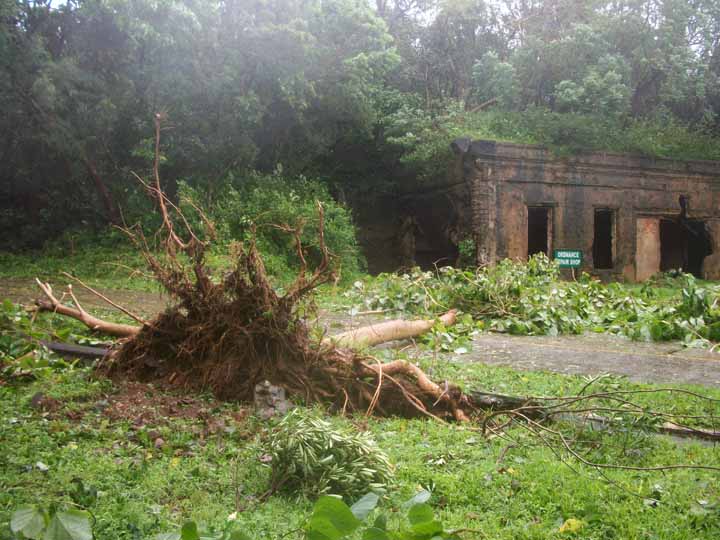
On the second morning – Wednesday – Steve took a walk from our house on Middleside, following the road to Topside. Workers were already busy clearing the fallen trees that were on the road, but it was evident from all of the leaf debris that a lot of damage had been done. Most obvious was a large, old tree at Topside which is in front of the former Fort Mills Administration Building. This massive tree completely blocked the road and a crew of six men worked the whole morning to cut and clear it. This required skillful chainsaw work, since it is very easy to pinch the blade when a tree is not lying flat on the ground.
The road in front of the Ordnance Repair Shop was blocked, a tree having been torn from the ground by its roots. It’s kind of surprising to us that a tree here could have such shallow roots, since it can often go six or seven months without measurable rainfall, but with the ground saturated it was hard even for deeper roots to withstand the wind gusts. Steve observed many trees down on the road to Batteries Hearn and Grubbs on the western part of Topside. Three of our bougainvilleas out front are lying on their sides and will have to be cut back to the ground to await new growth. A few of our cili (hot pepper) plants are lying down as well, though still rooted.
As he was walking back down to Middleside, Steve was surprised by what he saw at Battery Geary. In the middle of the batte ry is a hole in the ground where the central powder magazine was originally located. It was blown to bits by the Japanese in 1942, leaving a deep crater behind. It is temporarily a pond, with so much storm water having accumulated that it apparently has not yet had enough time to seep into the ground.
Steve was also able to drive down the hill to access the Internet on Wednesday morning, after missing email since Sunday. At the south beach, the waves were occasionally coming up as high as the dock. It was very difficult to photograph because the spray from the waves was hitting the camera lens. Also, winds were so strong at times that it was difficult to stand up straight. You can really feel the power of nature while standing on a beach, even at the backside of a typhoon. And remember, we weren’t even that close to the center of the storm!
Because of rough sea conditions, boat traffic is – of course – restricted by the Philippine Coast Guard. This has stranded a number of the island’s regular workers in Cabcaben on Bataan. And of course it means the banceros who bring supplies are not able to make their daily runs. We try to keep a good supply of non-perishables – canned fish, corned beef, Spam, spaghetti, rice, beans, etc., on hand just in case we are cut off from the mainland for an extended period of time. At present there is another storm that could choose to head our way…we hope it will track north of here. If not, we could be in for more surprises. Ahhh, tropical adventures!
Steve and Marcia on the very wet Rock
 he very first time on Tuesday. The occasion? The arrival of Typhoon Pedring, internationally named Nesat. This is easily the strongest typhoon to hit Corregidor since we have lived here, with the possible exception of Basyang, which blew through while we were in the States in July, 2010. Pedring was a very large storm, causing high winds here for over 48 hours, with eight i
 nches of rain measured in our backyard during a 24-hour period. Pretty amazing considering that the center of the storm was north of our area by a long shot. It was raining and blowing so hard that it reminded us of snow squalls at times. A young swallow even sought refuge under our over-hanging roof, clinging to the upper edge of our American flag.
The Corregidor “family” came through the storm unharmed. Because the 100-year-old drainage system is still functional, Corregidor can pretty much take all the rain a typhoon can dish out. Metro Manila, only 26 miles from here, is recovering from flood waters now, some of the worst along the Manila Bay beachfront in decades. We’ve been told that you can see some interesting footage of the waves shooting over Roxas Boulevard on YouTube. Try searching for “Manila” and “Pedring.” We also read that the American Embassy, which is along the bay, had some flooding.
It’s kind of strange spending a whole day indoors, but we really had no choice. The winds were so strong that if we left any windows open, things were blowing around inside the house, and rain blew in as well. Obviously one should not go outdoors during such storms, given the risk of being struck by flying objects or falling trees. Fortunately the house suffered no structural damage – it is quite sturdy – although we of course had damage to some trees and bushes. As usual the rains came in waves, super-heavy for awhile and then almost stopping briefly. We have encountered similar rain patterns in Michigan and Minnesota, but to our recollections they were always accompanied by lightning and didn’t last nearly so long. No lightening, no thunder with Pedring.
Normally when we lie in bed at night some of our bedroom windows are open, and we hear all kinds of sounds.
 Most of them are birds, frogs, lizards, and insects, especially crickets. Once in a while we will hear a branch fall, and sometimes we hear sounds that neither of us can identify. Almost never are these sounds scary. Recently Marcia awoke, hearing a scratchy sound at one of the bedroom window-screens. She had to drag Steve out of bed, and they walked toward the nearest open window, looking for what was making the sound. There, clinging to the outside of the screen, we spotted a land crab with maybe a 12-inch leg span, harmless but a little scary looking at four in the morning, especially having been startled from sleep.
Being inside in a totally closed house on the island is a different sensation entirely for us, the wind vacillating between near-calm and howling, and rain occasionally lashing the house as well. You feel kind of helpless, like there ought to be something you should be doing, but you just have to wait it out and trust that everything will be alright when you get up the next day.
On the second morning – Wednesday – Steve took
 a walk from our house on Middleside, following the road to Topside. Workers were already busy clearing the fallen trees that were on the road, but it was evident from all of the leaf debris that a lot of damage had been done. Most obvious was a large, old tree at Topside which is in front of the former Fort Mills Administration Building. This massive tree completely blocked the road and a crew of six men worked the whole morning to cut and clear it. This required skillful chainsaw work, since it is very easy to pinch the blade when a tree is not lying flat on the ground.
The road in front of the Ordnance Repair Shop was blocked, a tree having been torn from the ground by its roots. It’s kind of surprising to us that a tree here could have such shallow roots, since it can often go six or seven months without measurable
 rainfall, but with the ground saturated it was hard even for deeper roots to withstand the wind gusts. Steve observed many trees down on the road to Batteries Hearn and Grubbs on the western part of Topside. Three of our bougainvilleas out front are lying on their sides and will have to be cut back to the ground to await new growth. A few of our cili (hot pepper) plants are lying down as well, though still rooted.
As he was walking back down to Middleside, Steve was surprised by what he saw at Battery Geary. In the middle of the batte
 ry is a hole in the ground where the central powder magazine was originally located. It was blown to bits by the Japanese in 1942, leaving a deep crater behind. It is temporarily a pond, with so much storm water having accumulated that it apparently has not yet had enough time to seep into the ground.
Steve was also able to drive down the hill to access the Internet on Wednesday morning, after missing email since Sunday. At the south beach, the waves were occasionally coming up as high as the dock. It was very difficult to photograph because the spray from the waves was hitting the camera lens. Also, winds were so strong at times that it was difficult to stand up straight. You can really feel the power of nature while standing on a beach, even at the backside of a typhoon. And remember, we weren’t even that close to the center of the storm!
Because of rough sea conditions, boat traffic is – of course – restricted by the Philippine Coast Guard. This has stranded a number of the island’s regular workers in Cabcaben on Bataan. And of course it means the banceros who bring supplies are not able to make their daily runs. We try to keep a good supply of non-perishables – canned fish, corned beef, Spam, spaghetti, rice, beans, etc.,
 on hand just in case we are cut off from the mainland for an extended period of time. At present there is another storm that could choose to head our way…we hope it will track north of here. If not, we could be in for more surprises. Ahhh, tropical adventures!
Steve and Marcia on the very wet Rock
Friday, September 16, 2011
Buying basketball uniforms
Excitement is growing as everyone on the island anticipates the upcoming basketball tournament. To say that some of the players “can’t wait” would be an understatement. Soon after the announcement was made, 56 players had registered, and the 5 captains held a draft. The teams will be named after the five most-visited gun batteries on the island, namely Batteries Way, Hearn, Grubbs, Crockett, and Geary.
On Tuesday, our helper Roy and I took the 10-kilometer banca ride to Cabcaben, the first leg of our journey to Orion to order team uniforms. Off to the northwest, the Bataan Mountains were bright and beautiful in the morning sun as we departed, and the sea was calm and blue. We hadn’t traveled very far before we could see the aftereffects of a landslide that occurred recently along the old, now unmaintained north access road. Just the other day Marcia and I had walked that route with fellow Corregidor-lover Julia, and we were shocked to see the huge gaping void that now leads
  down to the shoreline. The landslide covered such a large area that it was impossible to get a decent photograph. Fortunately the road is still partially in place, but it may not take very much more rain – maybe the next major typhoon – for 100 feet or so of the road to disappear completely.
In Cabcaben we picked up Jerry and Rowena, who have a home there but reside most of the time on Corregidor. Because Orion is on the old highway (where the Death March took place) we had to travel partway by bus and then switch to a jeepney. I made the mistake of getting in the front seat which was made for Filipino legs. I had to sit sideways, and my left knee kept bumping into the metal dashboard, or more specifically, into a thin piece of metal running horizontally along the dash. I could not see out the front, the top third of the windshield being covered with a “Lord Guide Us” banner. Needless to say, the driver, about 18-inches shorter than I, had no trouble seeing the road. It was interesting from one standpoint: in the past we have observed how a man collects money on the local bus trips, somehow keeping track of all of the passengers and knowing exactly how many pesos to charge each one. In this case the driver not only has to maneuver his jeepney through often wild traffic, he has to collect fares and make change all at the same time! I handed him a 100 peso note for our foursome, and he returned a twenty peso note and four one peso coins, so I guess the Jeepney fare from Lamao to Orion is 19 pesos, or about 45 cents, each. Not bad.

Orion is a small town with a typically crowded main street, one MSE (medium-small enterprise) after another. My fellow travelers knew where to get off, and we proceeded to the uniform-making shop. It is a small store with knock-off team jerseys hanging on the wall. One man was cutting out jerseys, and several others were sewing them together on very old machines, one a Singer, another a Juki, and some on which I couldn’t see names. They were all treadle machines with elect ric conversions. One, which I have included in a picture, was like something I’d never seen before. The photo may make it appear quite large, but in fact it is probably only 8 by 10 inches surface-area and six inches in height. Just looking at the photo, Marcia thinks it may be some sort of serger.
We spent a couple of hours there, working with the proprietress and making sure that she understood exactly how each team’s uniforms were to appear, since they offer many options. I am not into NBA teams like folks are here, but I guess that they could say, “I want this uniform to look like the Chicago Bulls uniform,” and they would make it. For Jerry and Roy – captains for two of the teams – it was almost like watching them dreaming about what Santa was going to bring them for Christmas.
I think that the uniforms are a big part of the excitement of the upcoming tournament. Only one team is going to win the trophy, and only one player will be named tournament MVP. But every participant is going to get his very own jersey with his name on the back and the player number of his choice. Once this tournament is over, these young men will sport their uniforms until they wear them out, getting many years of use out of them. They are a source of pride that we are happy to be able to furnish them, with generous help from a number of our readers.
Once we were done, we headed to Balanga for lunch. I gave them their choice of where to eat, and they decided on a restaurant called Inasal, which is Ilongo for “barbecue.” Inasal has meals for around p90 ($2.00) which include limitless white rice. There’s nothing liked unlimited white rice to get you excited. Me not so much, although I must say that the food – I had a barbecued chicken leg quarter – was very good. Unlike Filipinos I can’t get excited about plain white rice, but the meal included a small bowl of sinigang, a soup with a sour broth, and that made the rice quite tasty. I had one extra half scoop of rice, the others each had two more full scoops. I was glad that they enjoyed their meals, too.
We took a tricycle to the restaurant and another after lunch to the bus terminal. Since there were four of us, we decided that the other three would share the sidecar while I would ride on the back of the motorcycle. The sidecar makes it impossible to sit astride the bike, so I sat sideways behind the driver. Some of the pedestrians must have been able to spot me a ways off. A number of them looked curiously in our direction, no doubt spotting my long, gangly, whiter-than-a-Filipino’s legs appearing from behind the driver’s rear end, with my head hidden behind the driver’s under the canopy. They smiled and laughed with me when they realized what they were actually seeing. Although I do not have a picture of myself in this position, I have included one of Keith, a guest on this year’s April tour.
We took the bus back to Cabcaben. Unlike conditions in the morning, the water was now grey and choppy. In fact, we didn’t head straight for the north dock, but started out heading more west toward Mariveles on the southern tip of Bataan before turning toward the north dock. The bancero knew what he was doing, because once we changed direction the going got rough. Some of the swells may have approached five feet, and we got a good splash each time the outrigger dug into a wave. It wasn’t dangerous, what with experienced boatmen and their sturdy boat. It was actually kind of fun being out on the open sea and at the mercy of Mother Nature. As we approached, Corregidor acted as a breakwater, but then it began to rain. Luckily I had my rain-jacket…safely tucked away inside my backpack, so it stayed dry, but most of the rest of me arrived back o n the Rock soaked to the skin.
I never get tired of taking this trip, knowing it is the same one that Gen. Jonathan Wainwright took many times in early 1942 to visit Gen. Douglas MacArthur on Corregidor – Mac only went in the other direction once to visit the troops, and that was in early January before the fighting in Bataan had gotten underway. I can only imagine, and not very well, I’m sure, what it must have been like to cross the North Channel, as Wainwright did more than once, with bombs falling and artillery shells flying overhead smashing into the Rock with such force that they are said to have reshaped the silhouette of the island. Can you imagine approaching Corregidor, seeing it under heavy siege, and then knowing you’d be spending the next few hours there? Kind of gives one a chill to even think about it.
On Tuesday, our helper Roy and I took the 10-kilometer banca ride to Cabcaben, the first leg
 of our journey to Orion to order team uniforms. Off to the northwest, the Bataan Mountains were bright and beautiful in the morning sun as we departed, and the sea was calm and blue. We hadn’t traveled very far before we could see the aftereffects of a landslide that occurred recently along the old, now unmaintained north access road. Just the other day Marcia and I had walked that route with fellow Corregidor-lover Julia, and we were shocked to see the huge gaping void that now leads
  down to the shoreline. The landslide covered such a large area that it was impossible to get a decent photograph. Fortunately the road is still partially in place, but it may not take very much more rain – maybe the next major typhoon – for 100 feet or so of the road to disappear completely.
In Cabcaben we picked up Jerry and Rowena, who have a home there but reside most of the time on Corregidor. Because Orion is on the old highway (where the Death March took place) we had to travel partway by bus and then switch to a jeepney. I made the mistake of getting in the front seat which was made for Filipino legs. I had to sit sideways, and my left knee kept bumping into the metal dashboard, or more specifically, into a thin piece of metal running horizontally along the dash. I could not see out the front, the top third of the windshield being covered with a “Lord Guide Us” banner. Needless to say, the driver, about 18-inches shorter than I, had no trouble seeing the road. It was interesting from one standpoint: in the past we have observed how a man collects money on the local bus trips, somehow keeping track of all of the passengers and knowing exactly how many pesos to charge each one. In this case the driver not only has to maneuver his jeepney through often wild traffic, he has to collect fares and make change all at the same time! I handed him a 100 peso note for our foursome, and he returned a twenty peso note and four one peso coins, so I guess the Jeepney fare from Lamao to Orion is 19 pesos, or about 45 cents, each. Not bad.

Orion is a small town with a typically crowded main street, one MSE (medium-small enterprise) after another. My fellow travelers knew where to get off, and we proceeded to the uniform-making shop. It is a small store with knock-off team jerseys hanging on the wall. One man was cutting out jerseys, and several others were sewing them together on very old machines, one a Singer, another a Juki, and some on which I couldn’t see names. They were all treadle machines with elect
 ric conversions. One, which I have included in a picture, was like something I’d never seen before. The photo may make it appear quite large, but in fact it is probably only 8 by 10 inches surface-area and six inches in height. Just looking at the photo, Marcia thinks it may be some sort of serger.
We spent a couple of hours there, working with the proprietress and making sure that she understood exactly how each team’s uniforms were to appear, since they offer many options. I am not into NBA teams like folks are here, but I guess that they could say, “I want this uniform to look like the Chicago Bulls uniform,” and they would make it. For Jerry and Roy – captains for two of the teams – it was almost like watching them dreaming about what Santa was going to bring them for Christmas.
I think that the uniforms are a big part of the excitement of the upcoming tournament. Only one team is going to win the trophy, and only one player will be named tournament MVP. But every participant is going to get his very own jersey with his name on the back and the player number of his choice. Once this tournament is over, these young men will sport their uniforms until they wear them out, getting many years of use out of them. They are a source of pride that we are happy to be able to furnish them, with generous help from a number of our readers.
Once we were done, we headed to Balanga for lunch. I gave them their choice of where to eat, and they decided on a restaurant called Inasal, which is Ilongo for “barbecue.” Inasal has meals for around p90 ($2.00) which include limitless white rice. There’s nothing liked unlimited white rice to get you excited. Me not so much, although I must say that the food – I had a barbecued chicken leg quarter – was very good. Unlike Filipinos I can’t get excited about plain white rice, but the meal included a small bowl of sinigang, a soup with a sour broth, and that made the rice quite tasty. I had one extra half scoop of rice, the others each had two more full scoops. I was glad that they enjoyed their meals, too.
We took a tricycle to the restaurant and another after lunch to the bus terminal. Since there were four of us, we decided that the other three would share the sidecar while I would ride on the back of the motorcycle. The sidecar makes it impossible to sit astride the bike, so I sat sideways behind the driver. Some of the pedestrians must have been able to spot me a ways off. A number of them looked curiously in our direction, no doubt spotting my long, gangly,
 whiter-than-a-Filipino’s legs appearing from behind the driver’s rear end, with my head hidden behind the driver’s under the canopy. They smiled and laughed with me when they realized what they were actually seeing. Although I do not have a picture of myself in this position, I have included one of Keith, a guest on this year’s April tour.
We took the bus back to Cabcaben. Unlike conditions in the morning, the water was now grey and choppy. In fact, we didn’t head straight for the north dock, but started out heading more west toward Mariveles on the southern tip of Bataan before turning toward the north dock. The bancero knew what he was doing, because once we changed direction the going got rough. Some of the swells may have approached five feet, and we got a good splash each time the outrigger dug into a wave. It wasn’t dangerous, what with experienced boatmen and their sturdy boat. It was actually kind of fun being out on the open sea and at the mercy of Mother Nature. As we approached, Corregidor acted as a breakwater, but then it began to rain. Luckily I had my rain-jacket…safely tucked away inside my backpack, so it stayed dry, but most of the rest of me arrived back o
 n the Rock soaked to the skin.
I never get tired of taking this trip, knowing it is the same one that Gen. Jonathan Wainwright took many times in early 1942 to visit Gen. Douglas MacArthur on Corregidor – Mac only went in the other direction once to visit the troops, and that was in early January before the fighting in Bataan had gotten underway. I can only imagine, and not very well, I’m sure, what it must have been like to cross the North Channel, as Wainwright did more than once, with bombs falling and artillery shells flying overhead smashing into the Rock with such force that they are said to have reshaped the silhouette of the island. Can you imagine approaching Corregidor, seeing it under heavy siege, and then knowing you’d be spending the next few hours there? Kind of gives one a chill to even think about it.
Tuesday, September 6, 2011
Corregidor basketball league
It’s still rainy season, and Steve has not conducted any tours since we returned, so there’s not much news to report. The book is in the editing process, with files going back and forth between us and the editorial staff.
We had a bit of excitement a few nights ago. Bear in mind that we have never heard of any spiders on Corregidor that are especially dangerous to humans, but this is the tropics and you can expect to run across the occasional spider. We were lying in bed, Marcia reading and Steve watching a video on his laptop, when Marcia spotted a rather lar ge spider on the other side of the bedroom just below the ceiling. Marcia reached across to her bedside table for the flyswatter, which was, quite frankly, narrower than the spider’s leg-span. This guy could have straddled a deck of playing cards.
Being that the spider was high up on the wall, Marcia told Steve the kill was his job – ah, the benefits of height. Steve was standing at an angle off to one side when he took a mighty swing. Wham! This guy was too large to get smashed into the wall, so guess what happened? That’s right, it behaved according to Newton’s “equal and opposite reaction.” The spider came flying back off the wall and landed right at Steve’s feet! We both jumped toward the bedroom doorway to make sure that the spider would not hop up looking for revenge. When we saw that it was balled up and not moving much, Steve went over and smacked it a couple times for good measure.
We wonder how a spider that size could have gotten into our house. Marcia also wondered if “spider guts” is part of the recipe for Rugby Contact Cement, because the clean-up the next morning took some real “elbow grease.” We’ve included a photo of the same type of spider, one that we saw outdoors – where they belong, in our way of thinking. It was not as large as the one in the bedroom, but still plenty big.

As we wrote in late 2008, shortly after we moved here, the annual Corregidor basketball tournament was held. We used the tournament as an opportunity to get to know a number of the players, mostly men employed on the island. It was a good competition with an exciting final round and an underdog winner.
It has been our aim ever since to get the tournament started again, and to be honest, the men on the island have been hoping that we would sponsor another tournament. Since the last tournament a number of the players have had to be laid off due to a poor economy. Last Christmas we decided that we’ve waited long enough and took the leap of faith that the money would be there when we needed it.
Knowing that some of you are willing to support us, we have begun to organize the new league. Steve has been named Commissioner. Previously the teams were divided by work groups; hotel staff, security staff, etc. This time we will appoint four captains who will pick their players by draft, in hopes of creating four roughly even-strength teams. Instead of the teams being named for their work groups they will be named for four of the points of interest on the island, such as Battery Way, Topside Barracks, Corregidor Inn, or Malinta Tunnel.
Each player will receive a unifo rm consisting of matching shirt and shorts. We have found a business that can supply them for a mere p650/$15.25 per set, quite reasonable considering that the shirts will have names and numbers. Each player will be expected to contribute p200/$4.70. Be aware that this is about two-thirds of a day’s pay here, not an insignificant amount to these men. We expect that there will be about 24 games in total, and each one will require two referees paid p200/$4.70 per game. Adding in incidentals such as a basketball or two, nets, etc, it’s easy to see how it will take about 50,000 pesos (around $1200 American) for the tournament to take place, of which the players’ contributions will cover about 20 percent.
We cannot tell you how excited many of the men are to have an other basketball tournament, and we are pleased to be able to help them make this happen. We have already received one generous donation that will cover about one-fourth of the costs, and another to cover the cost of one basketball. Some of you expressed an interest to help when we broached the subject before, and we are hoping that you will come through. It will take place in any case, but we are looking for anyone interested in furthering the tournament to step up and offer to help. We would be happy
  to name a team for your favorite Corregidor landmark for a significant contribution. However, no contribution is too small. If you are able to help with a non-tax-deductable gift please let us know soon and we will tell you how. We will make a full accounting to any contributor who asks, and should we exceed expenses we will bank the money for a future tournament.
We’ve included a few photos of the 2008 basketball tournament for your inspiration and amusement.
We had a bit of excitement a few nights ago. Bear in mind that we have never heard of any spiders on Corregidor that are especially dangerous to humans, but this is the tropics and you can expect to run across the occasional spider. We were lying in bed, Marcia reading and Steve watching a video on his laptop, when Marcia spotted a rather lar
 ge spider on the other side of the bedroom just below the ceiling. Marcia reached across to her bedside table for the flyswatter, which was, quite frankly, narrower than the spider’s leg-span. This guy could have straddled a deck of playing cards.
Being that the spider was high up on the wall, Marcia told Steve the kill was his job – ah, the benefits of height. Steve was standing at an angle off to one side when he took a mighty swing. Wham! This guy was too large to get smashed into the wall, so guess what happened? That’s right, it behaved according to Newton’s “equal and opposite reaction.” The spider came flying back off the wall and landed right at Steve’s feet! We both jumped toward the bedroom doorway to make sure that the spider would not hop up looking for revenge. When we saw that it was balled up and not moving much, Steve went over and smacked it a couple times for good measure.
We wonder how a spider that size could have gotten into our house. Marcia also wondered if “spider guts” is part of the recipe for Rugby Contact Cement, because the clean-up the next morning took some real “elbow grease.” We’ve included a photo of the same type of spider, one that we saw outdoors – where they belong, in our way of thinking. It was not as large as the one in the bedroom, but still plenty big.

As we wrote in late 2008, shortly after we moved here, the annual Corregidor basketball tournament was held. We used the tournament as an opportunity to get to know a number of the players, mostly men employed on the island. It was a good competition with an exciting final round and an underdog winner.
It has been our aim ever since to get the tournament started again, and to be honest, the men on the island have been hoping that we would sponsor another tournament. Since the last tournament a number of the players have had to be laid off due to a poor economy. Last Christmas we decided that we’ve waited long enough and took the leap of faith that the money would be there when we needed it.

Knowing that some of you are willing to support us, we have begun to organize the new league. Steve has been named Commissioner. Previously the teams were divided by work groups; hotel staff, security staff, etc. This time we will appoint four captains who will pick their players by draft, in hopes of creating four roughly even-strength teams. Instead of the teams being named for their work groups they will be named for four of the points of interest on the island, such as Battery Way, Topside Barracks, Corregidor Inn, or Malinta Tunnel.
Each player will receive a unifo
 rm consisting of matching shirt and shorts. We have found a business that can supply them for a mere p650/$15.25 per set, quite reasonable considering that the shirts will have names and numbers. Each player will be expected to contribute p200/$4.70. Be aware that this is about two-thirds of a day’s pay here, not an insignificant amount to these men. We expect that there will be about 24 games in total, and each one will require two referees paid p200/$4.70 per game. Adding in incidentals such as a basketball or two, nets, etc, it’s easy to see how it will take about 50,000 pesos (around $1200 American) for the tournament to take place, of which the players’ contributions will cover about 20 percent.
We cannot tell you how excited many of the men are to have an
 other basketball tournament, and we are pleased to be able to help them make this happen. We have already received one generous donation that will cover about one-fourth of the costs, and another to cover the cost of one basketball. Some of you expressed an interest to help when we broached the subject before, and we are hoping that you will come through. It will take place in any case, but we are looking for anyone interested in furthering the tournament to step up and offer to help. We would be happy
  to name a team for your favorite Corregidor landmark for a significant contribution. However, no contribution is too small. If you are able to help with a non-tax-deductable gift please let us know soon and we will tell you how. We will make a full accounting to any contributor who asks, and should we exceed expenses we will bank the money for a future tournament.
We’ve included a few photos of the 2008 basketball tournament for your inspiration and amusement.
Subscribe to:
Posts (Atom)
