Wednesday, September 25, 2013

Rain, rain, rain!

Starting on Sunday, September 15, we have had almost continuous rain for ten days straight.  As of now, we have received over 4 feet (1.2 meters) of the wet stuff.  Twice we’ve exceeded a foot in 24 hours.  This has been the result of Tropical Storm/Typhoon Usadi (Odette here in the Philippines) which must have been a monster because the eye never got within 500 kilometers of us as best we can tell.

As you should know, the island of Corregidor is mostly hills and cliffs, so most of the water manages to get to the ocean rather quickly.  But there are a few flat areas, man-made except for Bottomside, where it can take a while for the water to either soak in or find its way down the hill.
We went for a walk after one of the heavier rains and took a number of pictures that we want to share with you.  We started at Middleside Barracks just above our house, went to the major gun batteries along the road, went down to Bottomside, and then finished around our house.  We apologize that the pictures in some cases aren’t clearer, but they were taken during the rain.  Also, there has been a humidity haze, almost a fog, which is easy to see with the naked eye but just make some of the pictures look fuzzy.
When you walk around the island after major rains you hear the rush of running water and see waterfalls that are only there for very brief periods, except in this case where it JUST WON’T STOP RAINING!.  We jokingly refer to one such waterfall as Little Eaton Rapids, since the city of Eaton Rapids, Michigan, USA, where we lived before moving here, claims to be the only Eaton Rapids in the world.  It has been running steadily since this period of rain began.
Little Eaton Rapids (left)
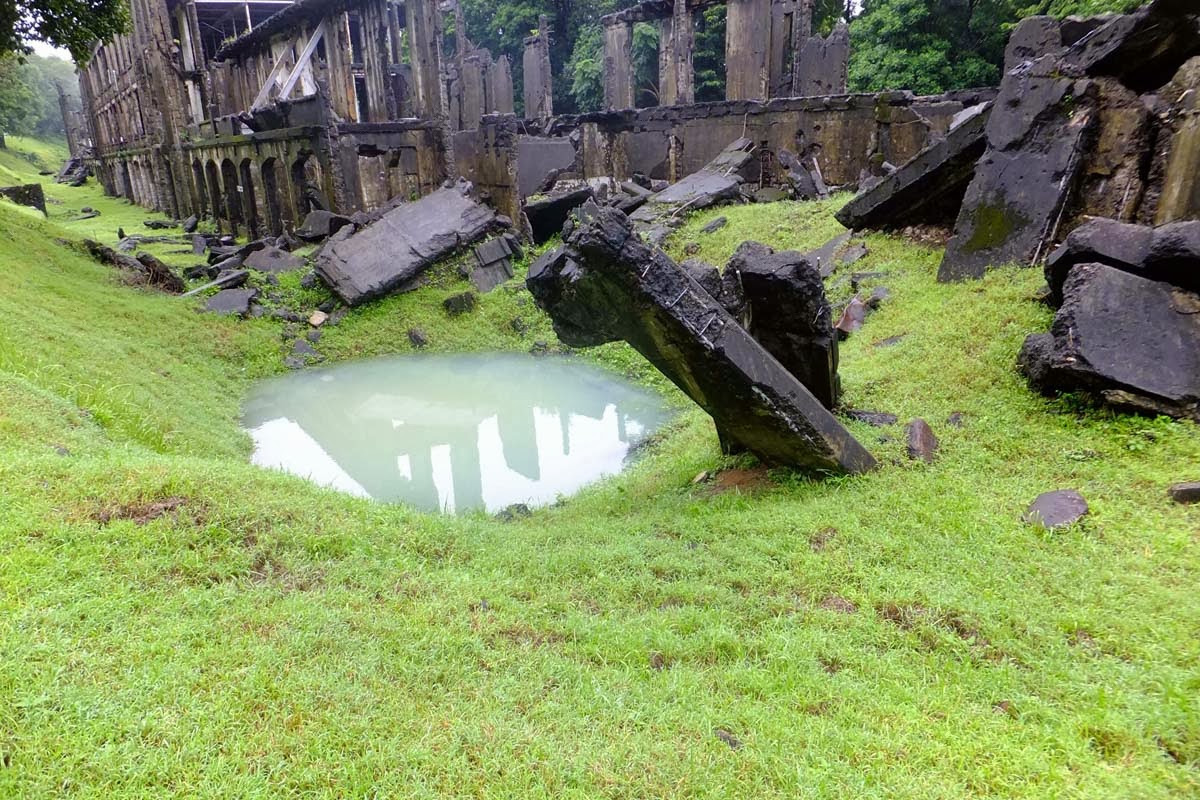
The gun pit below Battery Hearn is fuller than we have ever seen it.  The swimming pool which was part of the Officer’s Club area at Topside has several feet of water in it.  The most amazing for us was the completely flooded Battery Geary area.  We saw the center crater filled before, during the typhoons of 2009, but the water was not nearly as deep as this rain produced.
So take a look at the pictures, and remember us here on Corregidor, especially those of you who live in areas that would never come close to having this much water in such a short time period.
Steve and Marcia on the Rock
A new pond at Middleside Barracks

Flood at entrance to Battery Way

Small waterfall (center) at Battery Way

Water in gun pit, Battery Hearn

Several feet of water in the swimming pool, NCO Club

Battery Geary completely flooded, as seen from road above

Battery Geary

Battery Geary

Waterfall on retaining wall near Bottomside

Near MacArthur Cafe, Bottomside

 Between Admin Building and Motorpool, Bottomside

Middleside Reservoir looking like a lake

  
Our driveway; careful not to get stuck!

Road in front of our house, completely covered by water

Sunday, September 1, 2013

Constance Cowan meets Everett Reamer

A recent headline read, “Lanny Martinson, Vietnam Veteran, Finds Dog Tags on Facebook 45 Years Later.”  It was a story that made national news.  We thought this was a great story and are happy for Mr. Martinson, However, we think it pales in comparison to the story we brought you last month about James (Jimmy) and Constance Cowan.

Costance Cowan with Jimmy's dog tag

To recap, someone recently found a dog tag of James W. Cowan on Corregidor Island.  Over the years, hundreds – if not thousands – of dog tags have been found on Corregidor.  Many are on display in the museum.  But finding one today is expectedly rare.  Tour guide Armando Hildawa came into possession of Jimmy’s dog tag and entrusted it to American visitor Brandon Ainsworth.  Brandon, by clever use of the internet, tracked down Jimmy’s sister and only surviving sibling, Constance Cowan, age 87, of Duluth, Minnesota.  Since we were in the area during the months of July and August, Steve contacted Constance to set up a meeting.  Steve also contacted the American Cemetery in Manila to get photographs of Jimmy’s name on the Walls of the Missing, something Steve was sure that Constance would appreciate.
Steve thought that this story was newsworthy, and by chance met TV reporter and weekend weatherman Dave Anderson from KBJR, Channel 6 in Duluth, who initially sounded very interested in producing a feature story.  However, repeated follow-up emails went unanswered, so Steve contacted the editor of the Duluth News-Tribune.  Reporter Michael Creger was assigned the story, which appeared on the front page the day after the meeting took place.  Michael did a great job of not only telling the story of the dog tag but also included that Steve’s father, Walter, a Duluth native, had been in the same regiment as Jimmy on Corregidor, although the two were in different batteries.  He also told about our living on the Rock.  One thing that Michael failed to mention was that Constance and Jimmy Cowan are first cousins to former Minnesota Senator Walter Mondale.  Jimmy’s middle name is Walter, and multiple male relatives on that side of the family have Walter as first or middle name, not to be confused with Steve’s father.
As is usual in modern-day newspaper editions, it was only available on-line free of charge for a week.  Soon the Associated Press picked up the story, but to our dismay, they eliminated all references to Walter and to us.  Eventually we managed to find one website that contains the entire account – if you have not yet seen it, it is at:
To be clear, we point out that we had nothing to do with Constance initially receiving her brother’s dog tag.  However, had we not contacted the media, the story would have been untold.  In addition, the coincidences – that Walter was in the same regiment as James, was from the same city where Constance spent much of her life, and the fact that we now live on Corregidor – make the story more compelling, in our opinion. 
But the story does not end with our meeting in Duluth. 
During that get-together, Constance mentioned that her brother had been assigned to “F Battery” of the 60th Coast Artillery Regiment (60th CA).  While Steve is more familiar with his own father’s E Battery, he seemed to recall that Everett Reamer (WW II Corregidor veteran, POW, and dear friend) served in F Battery.  Steve told Constance a little of what he knew off the top of his head, mostly that the men in that battery manned anti-aircraft guns around Battery Cheney.  Constance said, “Oh, Jimmy would have loved that – he loved anything to do with big guns.”  By the way, Walter, Everett, and Jimmy entered the service at the same time, crossed the ocean on the same army transport ship (The Republic), and arrived on Corregidor on the same day.  But Jimmy didn’t make it home.
After returning to Virginia (MN), Steve called Everett at his home outside Cincinnati, Ohio, and asked him if he possibly remembered Jimmy Cowan.  Without hesitation Everett said, yes, he did.  At first all he could recall was that they were in the same battery and that they had taken a leave together to Manila when it was still peace-time.  By coincidence, Everett’s daughter lives in Hinckley, Minnesota, 75 miles south of Duluth, and he and his wife Bernice were planning to be there soon.  This gave Steve the idea of trying to get Everett and Constance together.
As it turned out, it was rather easy.  We had already made plans to drive from Virginia, where we had been staying with Steve’s mother, Mary Anne, to Minneapolis, where the three of us would spend several days with family before our flight back to the Philippines.  Hinckley was right along our route. 
We (Steve, Marcia and Mary Anne) arrived at David and Melissa’s house (son-in-law and daughter of the Reamers) and spent a few minutes meeting them and chatting with Everett, introducing him and Mary Anne to each other.  Bernice soon returned from a hair appointment to join us. 
Steve initially met Everett on his first tour to the Philippines, back in 2002.  Everett was one of five Corregidor and two Bataan defenders who made the trip for the 60th anniversary of the fall of the Philippines.  Steve immediately took to Malcolm Amos, a Death March survivor from Iowa whom we have mentioned on several occasions, and to Everett, who was in the 60th CA as was Steve’s father.  Both veterans could have been described as feisty and quick witted.  Later they were both on the 2006 tour that we took for the dedication of the Hell Ships Memorial in Subic Bay.  (We’ve included a picture.  Everett is second from left, Malcolm second from the right.)  And later in 2006 the Reamers and Malcolm were at the American Defenders of Bataan and Corregidor annual convention in Phoenix, Arizona, the first convention we attended.
Dick Francies, Everett Reamer, Malcolm Amos, and Chuck Towne

Soon, Constance and her cousin Eric Gibson arrived.  Connie told Everett a bit about her brother, showing him the dog tag and pictures of James.  Everett had had a couple of weeks to think about James, and after seeing his pictures, recalled that they were indeed very close.  They bunked together on the USAT Republic, were assigned to the F Battery, and even manned the same anti-aircraft gun!  Everett set the fuses and Jimmy worked the horizontal control.  (A third soldier worked the vertical control.)  On May 5, 1942 they were moved from their position to a point above James Ravine, in anticipation of a second Japanese landing which never came.
 Constance listens to Everett

Constance and cousin Eric

When asked by Connie why Jimmy’s dog tag would have been lost (and found) near the Malinta Tunnel, Everett had a plausible explanation.  On May 7, the morning after the surrender, many of the men – boys, in some cases; Everett was only 17 at the time – were ordered to stand outside the tunnel for a propaganda/publicity shot.  The soldiers were ordered to raise their hands and look at the camera.  A few, such as feisty Everett (seen circled in the attached photo) refused to obey.  Japanese soldiers took their bayonets and hooked them under the chains holding the American soldiers’ dog tags, yanked, and sent them flying.  The soldiers did not dare try to recover them.  Everett believes that Jimmy’s dog tag could very well have lain for 70 years near the very spot where it landed, and that Jimmy also in the same famous photograph.
Everett Reamer outside Malinta Tunnel, May 7, 1942

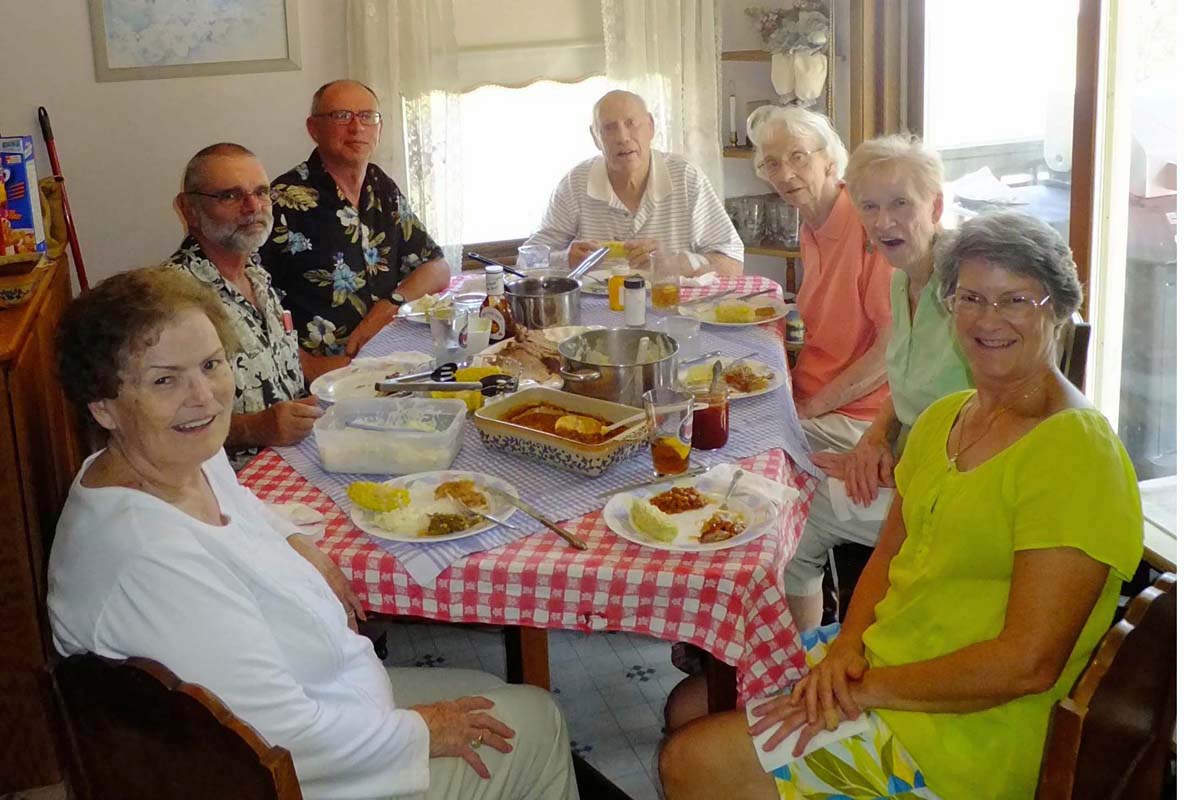
Melissa had prepared a sumptuous meal, typical of Midwestern hospitality, so we all sat down for lunch. 
 Lunchtime

After lunch, Steve overheard Melissa talking to Marcia about the scars on her father’s back.  It reminded Steve that he had never paid attention to the scars on his own father’s back, although Marcia noted them the first time she gave Walter a haircut.  So Steve asked if Everett would mind showing us the scars on his back from wounds inflicted by sadistic Japanese prison guards.  We took a picture, included here.  Be mindful that these scars have had 70 years to heal and that the camera cannot do them justice.  Nevertheless, Everett, who was once acknowledged by the Guinness Book of World Records for having been forced to stand at attention for 132 straight hours as punishment for attempting to steal Red Cross food packages withheld by the Japanese prison guards, still shows obvious signs of frequent, brutal beatings.  (Guinness has since rescinded the record, probably due to political pressure.)

Everett's scars

Finally we gathered in different groupings for photos, and said our goodbyes, which often take a long time in Minnesota.  We were so happy to see the Reamers again, as well as to bring Everett and Constance together for the first – we hope not last – time.

 Bernice and Marcia

Everett and Steve

Constance and Everett
If you find this story and set of coincidences intriguing, we encourage you to pass along this email or to contact the media, in an effort to give the story of Constance, Jimmy’s dog tag, and Everett Reamer, the coverage it deserves.
Steve and Marcia, back on the Rock

Saturday, August 3, 2013

Steve and Marcia in the news


We’ve been having a good time visiting with family and friends, dancing Slovenian polkas and waltzes, talking with and about local WW II veterans while doing research for a new book about some of the men from Minnesota’s Iron Range who became prisoners of the Japanese.  Included are photos of bricks dedicated to the memories of several of these men at the Iron Range Veterans Memorial in Virginia, Minnesota.

POWs Charles Snyder and Ed Pearsall

Reino Kallio (KIA); POWs Kenneth Davis and Walter Kwiecinski

Last week Marcia spent a few days with two of her sisters in the Minneapolis area.  The St. Paul Pioneer Press published an article about their youngest sister, Barbara, who died as a young child while a resident of a state hospital.  You can read about it at:

Marcia and her sister Jean Hockman looking at Barbara's gravestone

Yesterday we visited with a woman whose brother was in the same army regiment as Steve’s father, Walter.  You can read about Constance Cowan receiving her brother’s dog tag, recently found on Corregidor, almost 70 years after his tragic death on the Oryoku Maru.  Thanks to our friends at the American Cemetery in Manila, we were able to present her with pictures of her brother’s name (James W. Cowan) on Walls of the Missing.  The article was online in the Duluth News-Tribune for one week.  The Associated Press picked up the story and deleted all references to the two of us (Steve and Marcia) and Walter.  We are grateful to War History Online which reprinted the full story.  It can now be read at:

Connie and her cousin Eric Gibson holding photos and dog tag of James Cowan
 
Cowan James W Pvt 60 CA Regt Minnesota

We will be in central Michigan for the next 10 days and look forward to seeing some of our family and friends while we’re there.
Steve and Marcia, currently off the Rock

Thursday, June 27, 2013

A wild ride through the mountains with Michael Duncan

We spent a very enjoyable nine days in June with Michael Duncan of Nashville, Tennessee.  Michael’s father Walden was with the American Army, 37th Division, 129th regiment, here in the Philippines during the closing months of World War II and several months afterwards.  Walden arrived in mid-March, after the massive January 9, 1945 landing at Lingayen Gulf.  He was assigned to the 37th in April and became a driver, staying until mid-January 1946.  He spent the late-war months as part of operations from Manila northward to Aparri on the northern Luzon coast, and after the Japanese surrender travelled between San Fernando, La Union on the west coast of Luzon, to Cabanatuan, which is north of Manila in Nueva Ecija Province.
While here, Walden sent photos and almost 200 letters home to his wife and family, Michael having been born in 1942.  Michael has over 60 of these letters, and brought copies of the ones that specifically mentioned towns and dates.  His intention is to visit as many cities and towns as possible where he knows his father had spent time.  On this trip he was able to trace much of the route from Manila to Lingayen Gulf, toward Baguio, Aritao, and from Cabanatuan back to Manila.  It will take a second trip to cover the locations from Aritao north to Aparri, and he is already in the thinking stage for that.
Being unfamiliar with the Philippines, Michael contacted Vicky Middagh at Valor Tours of San Francisco and asked for help.  Vicky asked us if we would be interested in accompanying Michael, and we said yes, as long as he was aware that our knowledge of northern Luzon and the liberation of the Philippines was limited.  Michael agreed, and we met at the Manila Hotel for the first day of our tour, which we used to visit the American Cemetery in Manila.  On day two we toured more of the city, including Santo Tomas, Bilibid, and Intramuros, the old walled city very near the hotel.  The third day we rode to Angeles City and visited the Clark Museum at old Fort Stotsenberg.  Since we have shared many pictures of these areas before, we limited our attached photos to areas which were new for us.
In addition to helping Michael with his quest, we were excited to visit Lingayen Gulf and especially Baguio, the “Pine City.”  Many of you recall – in fact, some of you were with us – when back in 2009 we were scheduled to visit those areas as part of the 65th anniversary of MacArthur’s return to the Philippines.  But Typhoon Peping damaged the major roads to Baguio and we were forced to skip those sites, a disappointment not only to the paying customers but to the two of us as well.  We had heard so much about Baguio (BAHG-ee-oh) that we really wanted to get there, and this was the perfect opportunity.
So on day four we headed into parts untraveled by us, but we were in good hands.  Our driver Mario is familiar with the places we were going, and he is an excellent driver, which we really appreciated once we got into the mountains.  At this point we go to the pictures we included to help tell the story.

Michael in front of the Urdaneta Municipal Building.  One day while stationed at San Fernando in La Union Province, Walden drove to Urdaneta to have lunch at the Red Cross Station there…a 70 mile drive in what had to be very poor road conditions.  We had hoped to find someone who might know the location of that Red Cross Station, but we arrived on Saturday to find all municipal buildings closed except for the police station, and no answers.

Marcia and Michael walking in the Catholic Cemetery in Santa Barbara.  Walden mentioned seeing a cemetery there, and this, although not the same one, shows a typical Filipino cemetery with above-ground crypts.  The one Walden saw was consolidated into the American Cemetery by 1947.


Photos taken at the Lingayen Gulf Beach memorial, a beautiful tribute to the liberation forces.  It includes many interesting photos, maps, paintings, and landscaping.

Binmaley Catholic Church, including the tower which survived wartime devastation.


 Michael at Lingayen Beach.

The Unknown Soldier monument at Bauang, which as former Lions Club members we especially appreciated.

Michael posing at San Fernando Beach in a re-creation of a photo of his own father, who was 25 at the time the original was taken.

The beautiful Sacred Heart Church in Naguilian, a town and highway mentioned in the official history of the 37th Division which Michael brought with him.

The Naguilian River, also mentioned as “a stream” in the official history of the 37th Division.


Our first glimpses of Baguio, after a couple hours driving eastward up into the mountains.  Baguio is close to a mile high and has far different weather than Manila or Corregidor.  It wasn’t as cool as we expected, but quite comfortable.  But boy can it ever rain there, as it did for hours on our second night.


The Manor Hotel inside Camp John Hay.  The first Japanese bombs in the Philippines fell at this camp on December 8, 1941.  Notice the beautiful pine trees at this elevation.

he secured entrance to the American Embassy’s compound within Camp John Hay.  Here General Yamashita signed the official surrender documents, making CJH the first and last places touched by WW II here in the Philippines.

“The Mansion,” the Philippine president’s summer residence.

St. Bernard, whom we saw on the way down the steps to “Mines View.”

The mining area of Baguio, famous for gold and other precious metals.

Steve at the Baguio Texas Instruments sign.  Steve worked for TI in the late 1970’s in Austin, Texas.

Photo taken at the Philippine Military Academy.  These cadets are assigned to service branches after graduation, unlike the U.S., which has branch-specific academies. 

At this point Steve dropped our camera, rendering it dead.  The subsequent photos were provided thanks to Michael.

Baguio after we left the city heading eastward.

Lake Ambuclao, a dammed lake in the mountains.
There is almost no way to describe the drive from Baguio to Aritao.  Pictures and words just can’t do it justice.  It was one switchback after another, up and down the mountains for two and a half hours, with absolutely beautiful scenery all around us.  We were relying on Mario to keep us safe.  There were long sections with no straightaways at all, our heads constantly bobbing back and forth, left and right.  We said that there is no way to describe roads like these, but in fact, the Filipinos have the perfect phrase: “bitukang manok,” literally, “entrails of the chicken.”

This photowas taken the following morning to honor all of our friends from Indiana.  Notice Steve’s shirt: right colors, wrong state…he’s a Wisconsin (Superior) grad.

An Indiana cornfield in the middle of northern Luzon.

The marker at Balete aka Dalton Pass, the scene of very heavy fighting during the liberation.  Regular readers may remember that Steve accompanied Dr. Steve there last year.

An area of rice terraces south of Balete Pass.

The arch welcoming visitors into Cabanatuan City, another place Walden spent time.
We spent the last day with Michael touring Corregidor, and somewhat sadly sent him on the Sun Cruises ferry back to Manila to catch his plane home.  Since Michael did not get to the most northern parts of Luzon, the route from Cabanatuan to Aparri, we await his return.  Next time he hopes to come in January when the weather is more predictably pleasant and dry.  We were very fortunate that the daily rains cooperated with our sightseeing.
We’re heading to the U.S. for our annual two-month family and friends visit.  We’ll be back in late August, and don’t expect to write any newsletters while we’re gone.  See you in September.
Steve and Marcia on the Rock